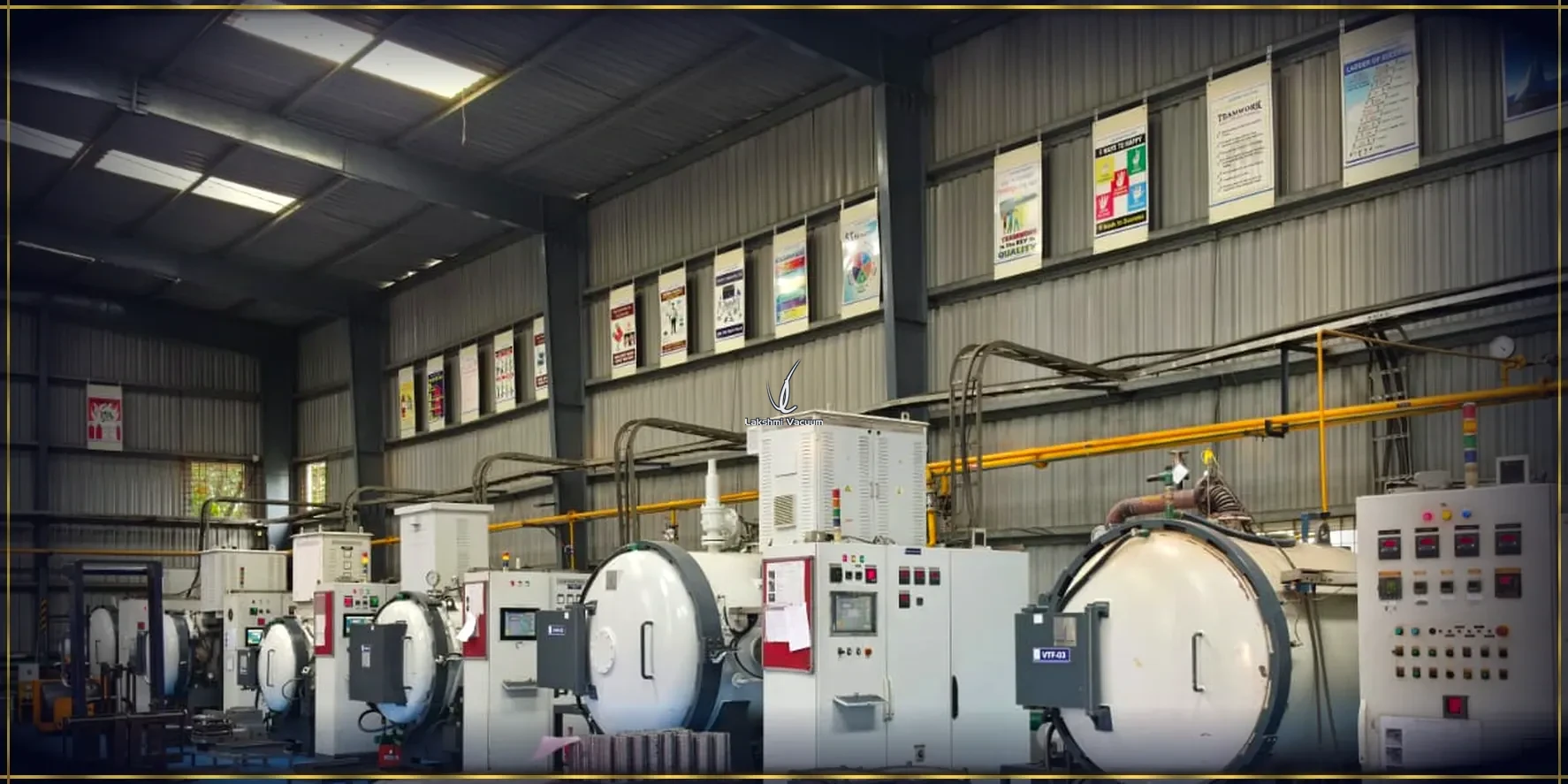
A vacuum furnace is used for any thermal process in which cleanliness and atmosphere control decide the result — brazing, sintering, annealing, hardening, carburizing, degassing, diffusion bonding, nitriding, hot pressing and melting. Running under vacuum removes oxygen and reactive gases, so parts come out bright, oxide-free and metallurgically consistent.
Lakshmi Vacuum Technologies builds a vacuum furnace for each of these processes, plus the instrumentation, spares and heat-treatment services that keep them running. Pick a process below to see how it works, what it is used for and the furnace specification that delivers it.
Clean, flux-free, high-strength joints for aerospace, automotive and tooling assemblies.
View brazing furnace →Densification of powders and MIM parts with controlled porosity and dimensional accuracy.
View sintering solutions →Bright annealing, stress relief and recrystallisation with no oxide scale or decarburisation.
View annealing furnace →High-pressure gas quenching for distortion-controlled hardening of tool and alloy steels.
View hardening furnace →Case-hardening with precise carbon control, without the oxygen-rich atmosphere of gas carburizing.
View carburizing furnace →Removal of dissolved gases and volatiles from metals and powders for cleaner downstream processing.
View degassing furnace →Solid-state joining of titanium, superalloys and dissimilar metals with no filler or melting.
View diffusion bonding →Simultaneous heat and uniaxial pressure for near-theoretical density and composite consolidation.
View hot press →High-purity melting and casting of reactive and specialty alloys free of atmospheric contamination.
View melting furnace →Surface hardening of tooling and components with minimal distortion and no compound-layer issues.
View nitriding furnace →Diffusion aluminide coatings for oxidation and corrosion resistance at high service temperatures.
View aluminizing furnace →Direct casting of thin strip from melt, bypassing several energy-intensive rolling steps.
View strip casting →Uniform, atmosphere-controlled tempering, ageing and drying for heat-treated components.
View vacuum ovens →Debinding and sintering of metal injection moulded parts in a single, contamination-free cycle.
View MIM solutions →Stress relief, homogenisation and heat treatment of 3D-printed metal parts without contamination.
View AM post-processing →Custom thermal cycles for R&D, crystal growth, graphite processing and advanced materials.
View R&D capabilities →These processes support aerospace, automotive, defence, medical, tool and die, energy, electrical and electronics, and general engineering manufacturers — with AMS 2750-compliant equipment and ISO-certified manufacturing. See our industry solutions for application detail.
Vacuum brazing, vacuum sintering, vacuum annealing (bright annealing and stress relief), vacuum hardening and tempering, vacuum carburizing, vacuum degassing, diffusion bonding, vacuum hot pressing, vacuum melting and casting, low-pressure nitriding, pack aluminizing and vacuum strip casting.
Start from the material and the property you need — hardness, ductility, joint integrity or surface chemistry — then match process, temperature, vacuum level, cooling method and load size. Our engineers help map your part to the correct cycle and furnace configuration.
Yes — many of our furnaces run several processes in one chamber by changing the recipe (for example hardening and tempering, or brazing and annealing), where the temperature range, hot zone and cooling system suit each cycle.