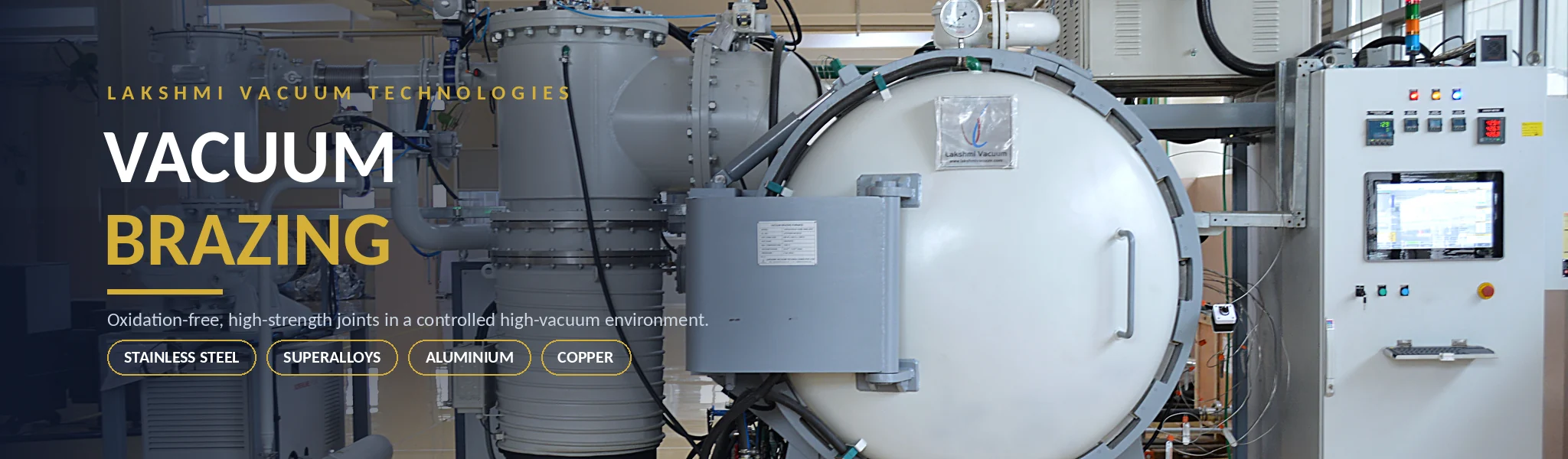
Vacuum Brazing Furnace · Overview
Clean, Flux-Free Joints in a Single Vacuum Cycle
Lakshmi Vacuum Technologies builds vacuum brazing furnaces that join dissimilar metals — stainless to copper, superalloys to carbide — in one clean, flux-free cycle at up to 1250°C. Parts come out bright, leak-tight and ready for critical service.
The vacuum does the work of chemical flux: with oxygen stripped from the chamber, capillary action draws molten filler through every joint interface and metallurgically bonds the assembly. No flux residue, minimal post-braze cleaning, consistent strength — cycle after cycle.
Every furnace is engineered to order at our Bengaluru works — hot zone, work-zone size, vacuum level and quench pressure configured around your parts, filler metals and production volumes.
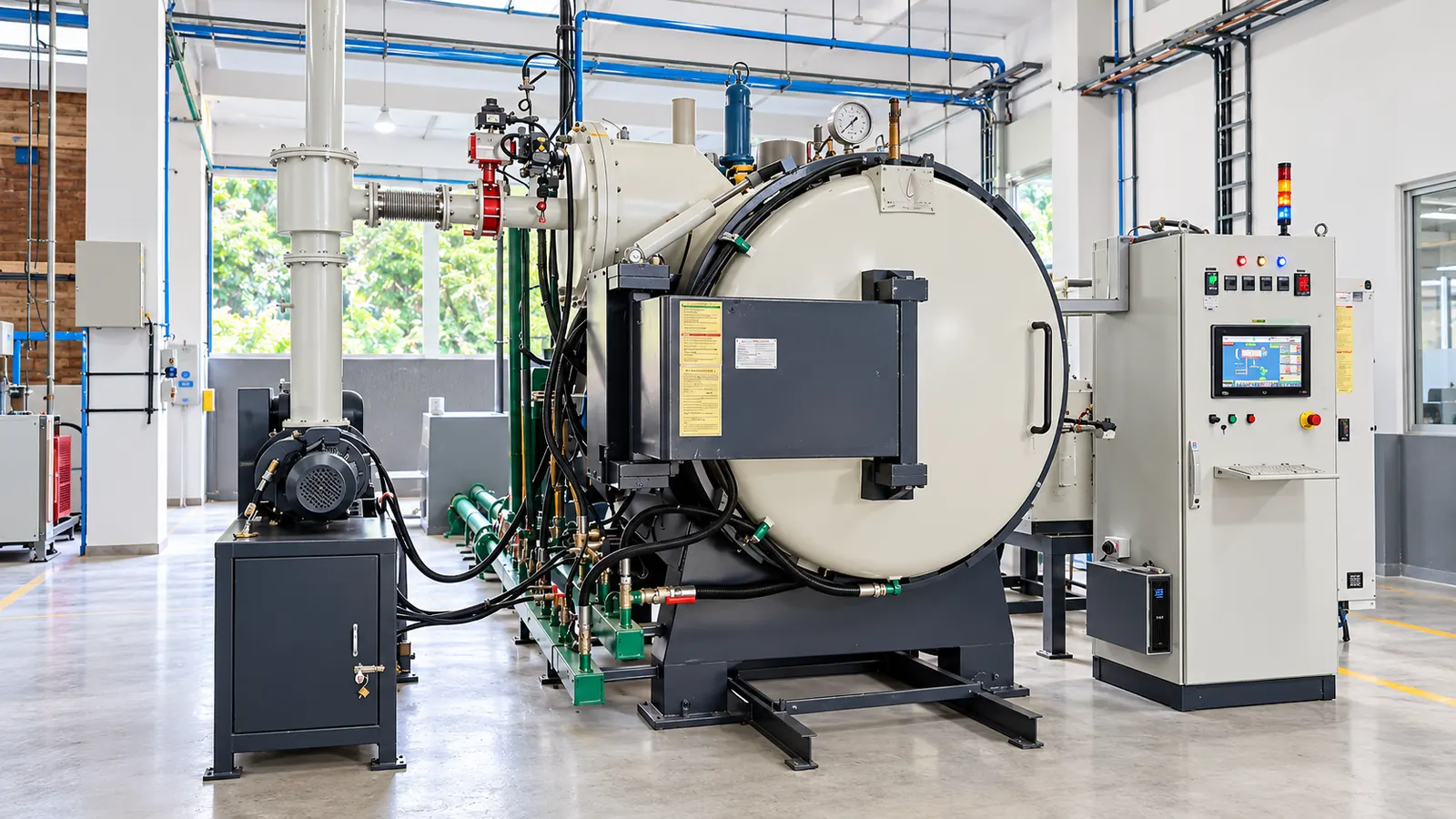 Work Zone up to 900 × 900 × 1200 mm
Process
How Vacuum Brazing Works
Load & Pump-Down
Assemblies are loaded with filler pre-placed at every joint. The chamber seals and pumps down to high vacuum, removing air and moisture.
Heat & Braze
Multi-zone elements raise the charge past the filler's melting point. Capillary action flows molten filler through each joint interface.
Quench & Unload
High-pressure nitrogen or argon (6–12 bar) rapidly cools the load. Parts unload clean, bright and flux-free.
Technical Specifications
Built to Spec, Engineered to Order
Working area, hot zone, vacuum level and quench pressure are all customized to your process. Send your drawings for a configured quotation.
Applications
Where This Furnace Earns Its Keep
Aerospace Assemblies
Fuel systems, sensors, heat shields and structural joints brazed to aerospace cleanliness standards.
Heat Exchangers & EGR Coolers
Leak-tight, flux-free joints across complex stainless and copper core assemblies.
Automotive Components
EGR coolers, oil coolers and sensor assemblies brazed in repeatable production volumes.
Cutting Tools & Tooling
Carbide-to-steel joints for drills, reamers, milling cutters and wear parts.
Precision Instruments & Sensors
Clean, dimensionally accurate joints where flux residue is unacceptable.
Electrical & Power Components
High-integrity copper and stainless assemblies for power applications.
Why Vacuum Brazing
The Case for Brazing Under Vacuum
No Flux, No Residue
The vacuum does the work of flux — joints finish bright and clean, cutting post-brazing cleaning and cost.
Dissimilar Metals, One Cycle
Stainless-to-copper, superalloy and carbide combinations joined reliably in a single run.
Uniform Multi-Zone Heating
PLC-controlled zones hold even temperature across complex multi-joint assemblies.
Production-Ready Build
Graphite or all-metal hot zones and 6–12 bar gas quench keep every cycle repeatable at scale.
FAQs
Frequently Asked Questions
What is vacuum brazing?
Vacuum brazing joins components by heating them above the melting point of a filler metal in a high-vacuum environment. Capillary action draws the filler into the joint, producing a strong, clean bond without oxidation or flux.
Which filler metals and materials can be used?
Nickel-based, copper-based and silver-based fillers are commonly used with stainless steels, copper, superalloys and other metals. The right combination depends on your base materials, service temperature and joint design.
Why choose vacuum brazing over conventional brazing?
The vacuum environment prevents oxidation and contamination, so joints are flux-free and clean, post-brazing cleaning is minimal, and joint quality is more consistent for critical assemblies.
What are the maximum temperature and vacuum level?
Our brazing furnaces operate up to 1250°C at 1 x 10⁻² mbar, with 10-6 mbar available if required for critical applications.
Can you braze large or heavy assemblies?
Yes. A typical system supports a 900 x 900 x 1200 mm working area and 900 kg charge, and working areas can be customised for larger, heavier, or specially shaped assemblies.
Do you offer brazing services alongside furnaces?
Yes. The group operates nine vacuum heat treatment locations across India, and brazing job work and trials can be arranged through your nearest unit.
Still have questions? Talk to our engineers or request a quotation.
Related Equipment