
Vacuum Hardening Furnace · Overview
Bright, Clean Hardening in One Vacuum Cycle
Lakshmi Vacuum Technologies builds high-performance vacuum hardening furnaces for tool and die steels, aerospace hardware, automotive tooling and precision components. Parts are austenitised in vacuum and quenched with high-pressure inert gas, so surfaces stay bright and free of scale.
With no air in the chamber there is no oxidation and no decarburisation — the hardness you specify is the hardness you measure, and there is no post-treatment machining or cleaning to pay for.
PLC/SCADA control with multi-zone uniformity and selectable quench pressures gives you a cooling curve matched to the section size and hardenability of each load, repeatable batch after batch.
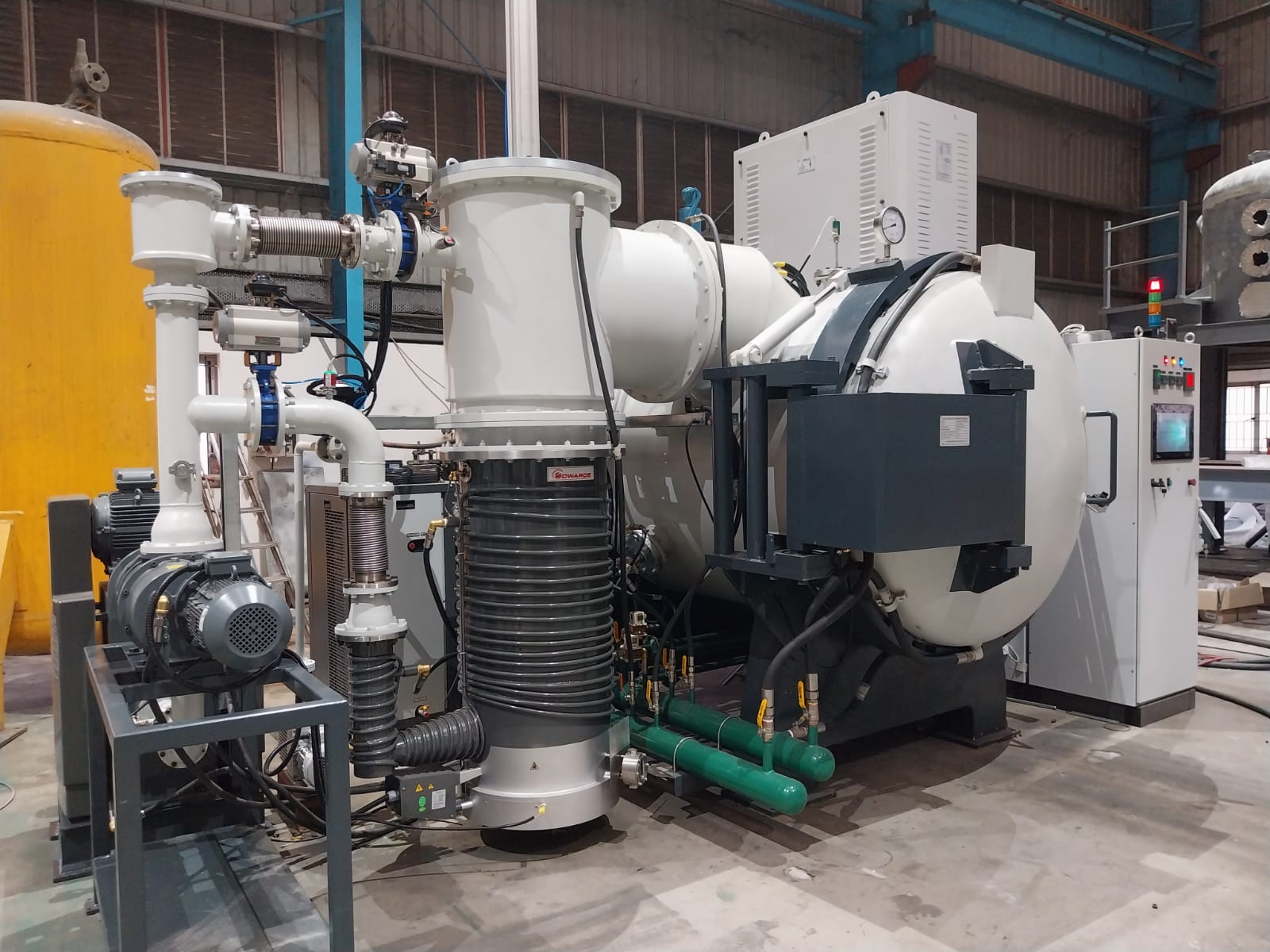 Work Zone up to 900 × 900 × 1200 mm
Process
How Vacuum Hardening Works
Load & Pump-Down
Parts are loaded and the chamber pumps down to high vacuum, removing air and moisture so the surface cannot oxidise or decarburise.
Austenitise in Vacuum
Multi-zone heating brings the load to its austenitising temperature — up to 1250°C — with uniform temperature throughout the charge.
Gas Quench & Unload
High-pressure nitrogen or argon (6–15 bar) cools the load at a controlled rate. Parts unload hard, bright and dimensionally stable.
Technical Specifications
Built to Spec, Engineered to Order
Working area, hot zone and quench pressures are customized to your process. Send your drawings for a configured quotation.
Applications
Where Our Vacuum Hardening Furnaces Are Used
Tool & Die Steels
H13, D2, M2 and other tool steels hardened bright and clean, with controlled gas quenching for the right hardness and toughness balance.
Aerospace Parts
Flight hardware hardened under vacuum with full process documentation and repeatable metallurgical results.
Automotive Tooling & Components
Dies, punches and transmission parts that demand consistent hardness from batch to batch.
High-Speed Steel Tooling
Drills, taps, broaches and milling cutters processed with controlled cooling to manage distortion.
Precision Moulds & Components
Plastic moulds and precision parts hardened without scaling, decarburisation or post-treatment machining.
General Engineering
Gears, shafts and machine elements requiring clean, repeatable vacuum hardening.
Why Lakshmi Vacuum
Bright, Clean Hardening with Gas Quenching Control
No Oxidation, No Decarburisation
Heating under high vacuum keeps surfaces bright and clean — no post-hardening machining or cleaning required.
Choose Your Cooling Curve
High-pressure nitrogen or argon quenching with selectable pressures matches the cooling rate to section size and hardenability.
Repeatable by Design
Multi-zone uniformity and PLC/SCADA recipe control deliver the same result cycle after cycle.
Backed by Real Experience
The group runs its own hardening, tempering and nitriding lines across nine Indian cities, with 450+ furnaces delivered since 2003.
FAQs
Frequently Asked Questions
What is vacuum hardening?
Vacuum hardening heats steel to its austenitising temperature under high vacuum, then rapidly cools it with high-pressure inert gas. The process produces a hard, wear-resistant structure with bright, contamination-free surfaces.
Which materials can be hardened in your furnaces?
Carbon steels, alloy steels, tool steels, high-speed steels and stainless steels are commonly processed. The correct cycle depends on the material grade, section size and required hardness.
How does gas quenching compare with oil quenching?
Gas quenching in vacuum avoids oil handling, smoke and post-cleaning, and gives precisely controllable cooling rates for minimal distortion. Modern high-pressure gas quenching covers a wide range of hardenability requirements.
What quenching pressures are available?
Systems are configured with high-pressure gas quenching at selectable pressure levels — 6, 10, 12 or 15 bar, or oil quench — and the right maximum pressure is chosen from your materials and load sizes.
Can the furnace also run tempering cycles?
Yes. Vacuum tempering, annealing and other sub-critical cycles can be run in the same furnace, and combined hardening-plus-tempering workflows are used across our own heat treatment units.
Can we trial our parts before purchasing a furnace?
Yes. Nine Lakshmi Vacuum heat treatment units across India can process your parts as job work, so you can evaluate results before configuring your own system.
Still have questions? Talk to our engineers or request a quotation.
Related Equipment