

Advanced Low Pressure Nitriding Furnaces
Lakshmi Vacuum Technologies manufactures advanced low pressure nitriding furnaces engineered to significantly enhance the surface hardness, wear resistance, and fatigue life of critical steel components. This process is vital for the automotive, aerospace, and tooling industries, particularly for high-stress parts like gears, crankshafts, and injection molds.
By operating at temperatures between 450–700°C in a controlled, low-pressure nitrogen-rich atmosphere (using Ammonia or N₂+H₂ mixtures), our furnaces diffuse nitrogen into the metal surface. This forms a hard, durable nitride layer without the environmental hazards of traditional salt bath nitriding and without causing surface oxidation.
Designed to meet stringent aerospace standards like AMS 2750, our systems feature precise temperature uniformity (±5°C) and advanced PLC/SCADA control. This guarantees highly repeatable metallurgical results, ensuring your components achieve exact case depths and superior mechanical properties every cycle.
Request Quotation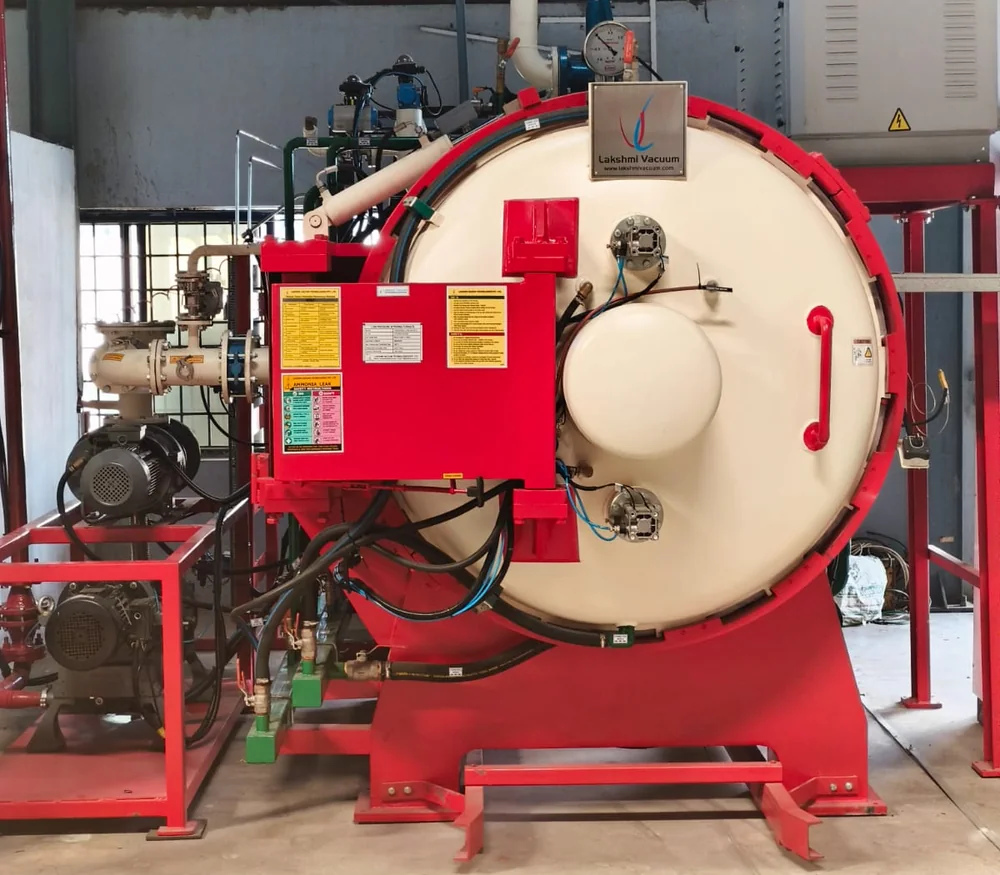
How It Works
Low pressure nitriding diffuses nitrogen into metal surfaces under controlled low pressure to enhance hardness, wear, and fatigue resistance. Parts are heated to 450–700°C in a low-pressure nitrogen-rich atmosphere; nitrogen forms a hard nitride layer without surface oxidation.
Technical Specifications
Standard configuration — working area, hot zone and controls customised to your parts and volumes.
| # | Parameter | Technical Details |
|---|---|---|
| 1 | Useful Working Area | 900 × 900 × 1200 mm / Customizable |
| 2 | Maximum Temperature | 700°C |
| 3 | Hot Zone | Graphite / All Metal |
| 4 | Vacuum Level | 1 × 10⁻² mbar |
| 5 | Charge Weight | 900 kg |
| 6 | Furnace Vessel | Carbon Steel / SS |
| 7 | Temperature Uniformity | ±5°C (AMS 2750) |
| 8 | No. of Zones | 1 or 3 Zones |
| 9 | Power Supply | 415V AC, 50 Hz, 3-phase |
| 10 | Process Gas | Ammonia (NH₃) and/or Nitrogen + Hydrogen |
| 11 | Control System | PLC, IPC with SCADA |
| 12 | Application | Automotive gears, aircraft landing gear, injection molds |
| 13 | Cooling System | Gas cooling (Nitrogen, Helium) |
Parts and Industries That Rely on Our Nitriding Furnaces
Automotive Gears and Shafts
Surface hardening of gears, crankshafts and transmission parts for higher load capacity, wear resistance and fatigue life.
Die Casting and Forging Dies
H13 and other hot-work tooling treated for extended die life through a tough, wear-resistant nitride layer.
Injection Moulds and Screws
Wear and corrosion protection for moulds, extrusion screws and barrels where distortion must stay minimal.
Hydraulic Components
Shafts, cylinders, pistons and valves hardened for combined wear and corrosion resistance.
Aerospace Components
Landing gear parts and flight hardware processed to AMS 2750-aligned standards with tight uniformity.
General Precision Engineering
Camshafts, spindles and machine elements that need a hard surface with a tough core.
Clean Nitriding Without Salt Bath Hazards
Low-Pressure Process
Nitrogen diffused in controlled low-pressure atmosphere using ammonia or N₂+H₂ mixtures — no salt bath handling, no environmental hazards, no surface oxidation.
Tight Uniformity
Temperature uniformity of ±5°C with PLC/SCADA control delivers exact, repeatable case depths cycle after cycle.
Aerospace-Grade Discipline
Designed to meet standards such as AMS 2750, with graphite or all-metal hot zones and automated recipe control.
Group-Wide Support
Commissioning, operator training, spares, thermocouple calibration and AMC from one integrated group.
Frequently Asked Questions
What is low pressure nitriding and how does it differ from gas or salt bath nitriding?
Low pressure nitriding diffuses nitrogen into steel at 450-700°C in a controlled low-pressure atmosphere. Compared with salt bath nitriding it avoids hazardous salts and surface oxidation, and compared with conventional gas nitriding it gives tighter control of the atmosphere and case depth.
Which materials can be nitrided in your furnaces?
Typical materials include alloy steels, hot-work and cold-work tool steels, and certain stainless grades. Common parts include gears, dies, moulds, shafts and hydraulic components. Our engineers can advise on suitability for your specific steel.
Why choose nitriding instead of quench hardening for some parts?
Nitriding adds a hard, wear-resistant surface layer while keeping the core tough, and is often chosen where minimal distortion matters — for example on finished gears and dies.
Do you provide nitriding as a service, or only the furnaces?
Both. The Lakshmi Vacuum Group manufactures the furnaces and also runs nine vacuum heat treatment units across India where nitriding and related processes are offered as job work and production services.
Can the furnace be integrated into an existing production line?
Yes. Systems are built around PLC and SCADA controls with recipe management, and can be configured for manual, semi-automatic or fully automatic operation to fit your workflow.
What capacities are available?
A typical system offers a 900 x 900 x 1200 mm working area with 900 kg charge weight, with working area, hot zone and controls customised to your parts and volumes.
Still have questions? Talk to our engineers or request a quotation.
Explore Other Vacuum Furnace Systems
Need a Custom Configuration?
Our engineers can customize working area, gas flow dynamics, and temperature uniformity to your exact process requirements.
Request Quotation