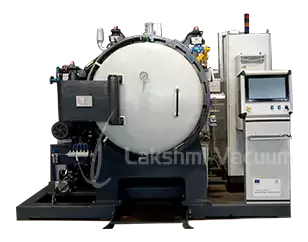
Lakshmi Vacuum Technologies manufactures state-of-the-art vacuum carburizing furnaces engineered for high-performance surface hardening of steel components. This low-pressure carburizing process is highly sought after in the automotive, aerospace, and heavy machinery industries for parts requiring exceptional wear resistance and core toughness.
By introducing hydrocarbon gases (such as acetylene or propane) under a vacuum environment, carbon diffuses deeply and uniformly into the component's surface. This method eliminates the intergranular oxidation (IGO) commonly associated with traditional atmosphere carburizing, resulting in superior metallurgical integrity and cleaner parts.
Following the diffusion phase, components undergo rapid high-pressure gas quenching (up to 20 bar) using inert gases. Integrated with advanced PLC/SCADA systems, our furnaces ensure precise control over carbon depth, case hardness, and dimensional stability, delivering repeatable results for critical gears, shafts, and transmission components.
| # | Parameter | Technical Details |
|---|---|---|
| 1 | Useful Working Area | 900 × 900 × 1200 mm / Customizable |
| 2 | Maximum Temperature | 1250°C |
| 3 | Hot Zone | Graphite / All Metal |
| 4 | Vacuum Level | 1 × 10⁻² mbar (10⁻⁶ if required) |
| 5 | Charge Weight | 900 kg |
| 6 | Furnace Vessel | Carbon Steel / SS |
| 7 | Max Quenching Pressure | 10 / 12 / 15 / 20 bar or oil quench |
| 8 | No. of Zones | 1 or 3 Zones |
| 9 | Power Supply | 415V AC, 50 Hz, 3-phase |
| 10 | Process Gas | Acetylene, Propane, Methane |
| 11 | Control System | PLC, IPC with SCADA |
| 12 | Application | Gear parts, transmission components, tool steels |
| 13 | Cooling System | High-pressure inert gas quenching (N₂ / Ar) |
Our engineers can customize working area, gas flow dynamics, and quench pressures to your exact process requirements.
Speak to Expert