
Vacuum Sintering Furnace · Overview
Strong, Dense, Contamination-Free Parts from Powder
Lakshmi Vacuum Technologies builds high-temperature vacuum sintering furnaces for powder metallurgy, carbide tools, MIM parts, ceramics and advanced composites. Your compacts are densified in vacuum or argon, up to 2000°C, without oxidation or impurities.
Because there is no air in the chamber, powder particles bond at the molecular level — giving you high-density components with consistent metallurgical properties, bright surfaces and no post-process cleaning for oxidation.
Graphite hot zones, multi-zone control and PLC/SCADA automation hold temperature uniformity across the whole load, so the properties you qualify on the first batch are the properties you get on the next one.
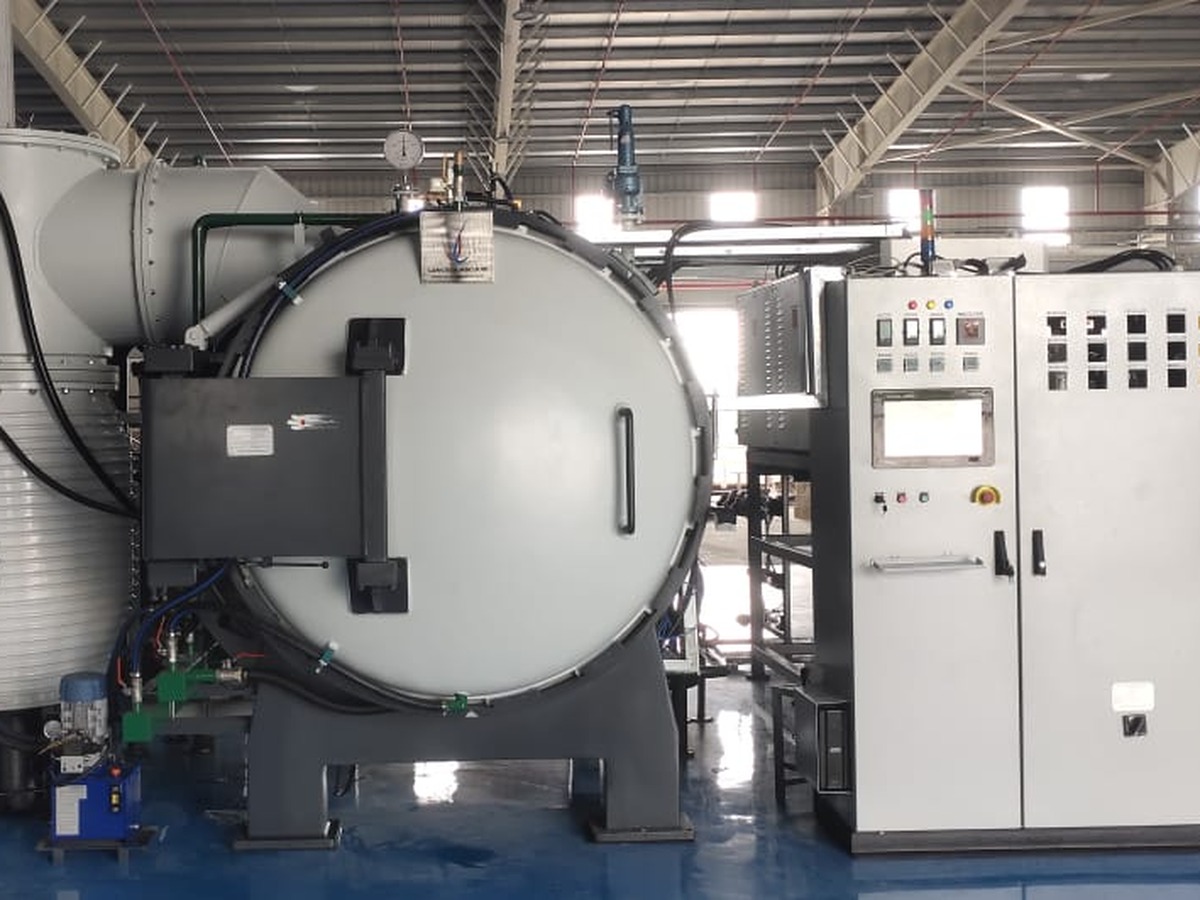 Work Zone up to 900 × 900 × 1200 mm
Process
How Vacuum Sintering Works
Compact & Load
Powder is compacted into the part shape and loaded with graphite fixturing. The chamber seals and pumps down, removing air, moisture and binders.
Sinter Under Vacuum or Argon
Parts are heated below the melting point — up to 2000°C — so particles bond and the compact densifies without oxidation or contamination.
Cool & Unload
Water-cooled chamber walls and optional gas quenching (6–15 bar) bring the load down under control. Parts come out dense, bright and ready to use.
Technical Specifications
Built to Spec, Engineered to Order
Working area, hot zone, temperature and quench pressure are all customized to your process. Send your drawings for a configured quotation.
Applications
Where Our Sintering Furnaces Are Used
Carbide & Cermet Tools
Tungsten carbide inserts, drills, end mills and wear parts sintered up to 2000°C for full density and consistent hardness.
Powder Metallurgy Components
Structural PM parts such as gears, bushings, sprockets and bearings densified under vacuum or argon for clean, repeatable properties.
Metal Injection Moulding
Debinding and sintering of small precision MIM parts for automotive, medical and consumer applications.
Technical Ceramics & CMCs
Oxide and non-oxide ceramics and ceramic matrix composites sintered without oxidation, for high-temperature service.
Magnetic & Electronic Materials
Soft and hard magnetic materials and electronic ceramics requiring controlled atmospheres and clean surfaces.
Aerospace & Defence
Flight-critical sintered components processed with tight uniformity, full traceability and clean-surface requirements.
Why Lakshmi Vacuum
Built by Engineers Who Run Sintering Furnaces Every Day
Process-First Engineering
The group runs its own vacuum heat treatment and sintering units across India, so every design starts from production experience, not theory.
Hot Zone Expertise
Graphite and all-metal hot zones matched to your temperature, atmosphere and cleanliness requirements.
Precise and Repeatable
Multi-zone temperature control with PLC/SCADA automation for repeatability batch after batch.
One Partner, Full Support
Installation, training, spares, calibration and AMC from one group, with 450+ furnaces delivered since 2003.
FAQs
Frequently Asked Questions
What is vacuum sintering used for?
Vacuum sintering densifies metal and ceramic powders by heating them below melting point in a controlled atmosphere. It is used for carbide tools, powder metallurgy parts, MIM components, ceramics and other high-performance materials that must stay contamination-free.
What maximum temperature do your sintering furnaces reach?
Our systems are offered with working temperatures from 1250°C up to 2000°C, with graphite hot zones designed for sustained high-temperature cycles. The right configuration depends on your material and process.
What vacuum level and atmosphere do you support?
Standard systems run at 1 × 10⁻² mbar with 10⁻⁶ mbar available if required, and support vacuum or argon atmospheres to suit the material being processed.
What size and load capacity are available?
A typical system offers a 900 × 900 × 1200 mm useful working area and 900 kg charge weight, and we customise the working area, hot zone and quench pressures to your exact process.
Do your sintering furnaces support gas quenching?
Yes. Quenching pressures of 6, 10, 12 or 15 bar can be specified depending on the material and cooling rate your process requires.
Can we run trials or send parts before buying?
Yes. The group runs nine vacuum heat treatment units across India, so trials, job work and pilot batches can be arranged alongside your furnace selection process.
Still have questions? Talk to our engineers or request a quotation.
Related Equipment