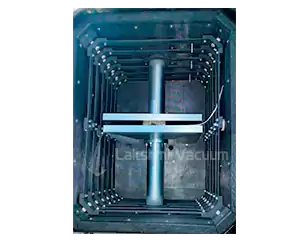
Lakshmi Vacuum Technologies manufactures high-performance vacuum hot presses engineered for the densification of advanced powders and the diffusion bonding of critical materials. Our systems are indispensable for producing high-density, defect-free components in the aerospace, and advanced ceramics industries.
By combining extreme temperatures (up to 2200°C) with uniaxial hydraulic pressure (up to 100 tons) in a vacuum environment, our hot presses accelerate densification and prevent oxidation. This process produces materials with superior mechanical properties, fine microstructures, and near-theoretical density, which are unachievable through conventional sintering alone.
Featuring robust graphite or molybdenum hot zones, advanced multi-zone resistance heating, and sophisticated PLC/SCADA control systems, our vacuum hot presses ensure precise alignment, temperature uniformity, and absolute repeatability for your most demanding powder metallurgy and composite manufacturing applications.
Vacuum hot pressing is chosen wherever a powder must reach near-full density, or where materials must be consolidated or joined without melting. Typical applications include:
| # | Parameter | Technical Details |
|---|---|---|
| 1 | Max Temperature | Up to 2200°C (graphite/molybdenum heaters) |
| 2 | Max Pressure | Up to 100 tons (hydraulic press) |
| 3 | Heating Zone Size | Ø100 – Ø600 mm (custom available) |
| 4 | Vacuum Level | 10⁻³ – 10⁻⁵ mbar |
| 5 | Atmosphere | Vacuum / Inert gas (Argon, Nitrogen) |
| 6 | Control System | PLC, IPC with SCADA, DAS optional |
| 7 | Heating Type | Resistance heating with multi-zone control |
| 8 | Cooling System | Water-cooled components |
| 9 | Applications | Powder sintering, diffusion bonding, composite pressing |
Our engineers can customize heating zone sizes, pressure capacities, and vacuum levels to your exact process requirements.
Speak to ExpertDensification of structural ceramics and composites to near-theoretical density.
Consolidation of high-performance powders and diffusion bonding of critical assemblies.
Combined heat and uniaxial pressure for composite consolidation without porosity.
Solid-state joining of similar and dissimilar materials in a clean vacuum environment.
Processing of specialised materials requiring precise atmosphere and pressure control.
Process development for next-generation powder metallurgy and materials research.
Graphite or molybdenum hot zones with multi-zone resistance heating for demanding materials.
Hydraulic uniaxial pressing with precise alignment and force control through the full cycle.
Prevents oxidation and contamination while accelerating densification.
PLC/SCADA control delivers repeatable temperature, pressure and position profiles.
Vacuum hot pressing combines high temperature with uniaxial pressure to densify powders and bond materials - producing near-theoretical density parts that conventional sintering alone cannot achieve.
Sintering relies on heat alone; hot pressing adds mechanical pressure during the cycle, enabling higher density at lower temperatures and shorter cycles for many materials.
Our systems are engineered up to 2200°C with pressing force up to 100 tons, configured around your material and tooling.
Advanced ceramics, metal matrix composites, aerospace powders and specialised alloys used in energy and nuclear applications.
Yes - discuss your powder or assembly with our engineers and we will define a trial plan and configuration.
Still have questions? Talk to our engineers or request a quotation.