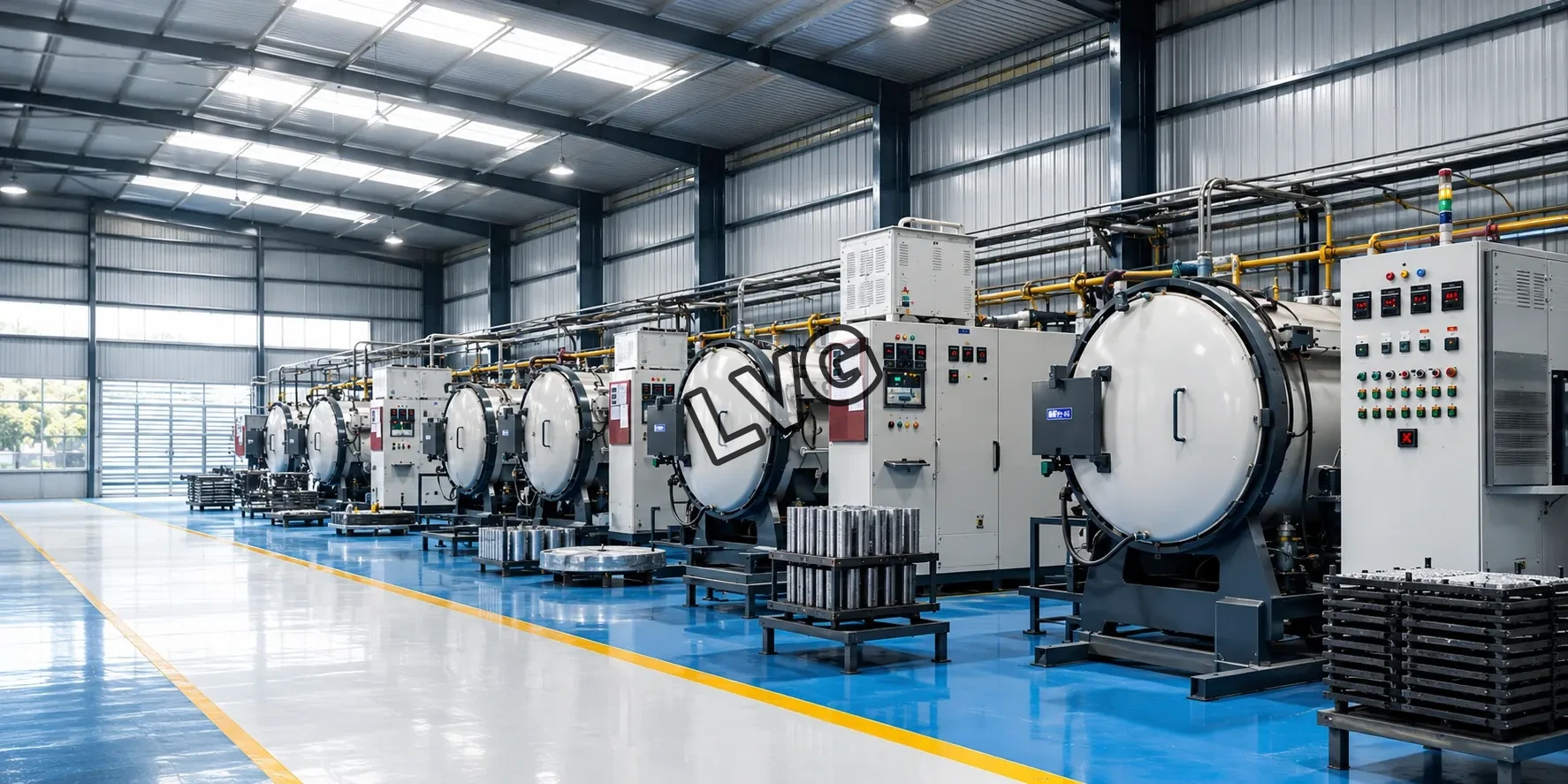
Vacuum annealing is a heat treatment that softens metal, removes internal stress and refines grain structure by heating a part in a vacuum and cooling it under controlled conditions. Because no oxygen is present, the surface stays bright and oxide-free — so there is no scale to pickle, no decarburisation and no post-cleaning.
Lakshmi Vacuum Technologies manufactures vacuum annealing furnaces for bright annealing, stress-relief annealing, recrystallisation and solution annealing of carbon and alloy steels, stainless steel, copper and brass, nickel alloys, titanium, and additively manufactured (3D-printed) metal parts.
Every furnace combines a graphite or all-metal hot zone, multi-zone resistance heating and PLC/SCADA recipe control to deliver uniform temperature and repeatable metallurgical results, certified to AMS 2750 with ± 3 °C and ± 6 °C uniformity options.
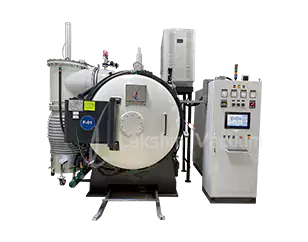
Vacuum annealing furnaces are used across aerospace, automotive, tool & die, medical, defence and research applications — including stress relief of 3D-printed components, bright annealing of stainless and copper assemblies, and pre-machining softening of tool steels and forging stock.
| # | Parameter | Technical Details |
|---|---|---|
| 1 | Useful Working Area | 900 × 900 × 1200 mm / Customisable |
| 2 | Maximum Temperature | 1300°C (typ. 850–1250°C cycles) |
| 3 | Hot Zone | Graphite / All-metal (molybdenum) |
| 4 | Vacuum Level | 10⁻² – 10⁻⁵ mbar; partial pressure N₂ / Ar |
| 5 | Charge Weight | Up to 1000 kg / Customisable |
| 6 | Furnace Vessel | Carbon Steel / SS |
| 7 | Cooling | Controlled gas cooling (N₂ / Ar) / Slow cool |
| 8 | No. of Zones | 1 or 3 Zones |
| 9 | Temperature Uniformity | ± 3 °C / ± 6 °C (AMS 2750) |
| 10 | Control System | PLC, IPC with SCADA, recipe-based cycles |
| 11 | Power Supply | 415V AC, 50 Hz, 3-phase |
| 12 | Application | Bright, stress-relief, recrystallisation, solution annealing |
It softens metal, relieves internal stress, refines grain structure and restores ductility before or after machining and forming. Because it runs without oxygen, parts come out bright and oxide-free, so pickling and post-cleaning are usually unnecessary.
Bright annealing is the result, not a different process — annealing under vacuum produces a bright, scale-free surface. A vacuum annealing furnace achieves the same metallurgical outcome as conventional annealing without oxidation or decarburisation.
Yes. Vacuum annealing is widely used as post-processing for additively manufactured metal parts to relieve printing stresses, homogenise microstructure and improve ductility without contaminating internal channels.
Our engineers can customise working area, hot zone, vacuum level and cooling profile to match your material and cycle requirements.
Speak to Expert