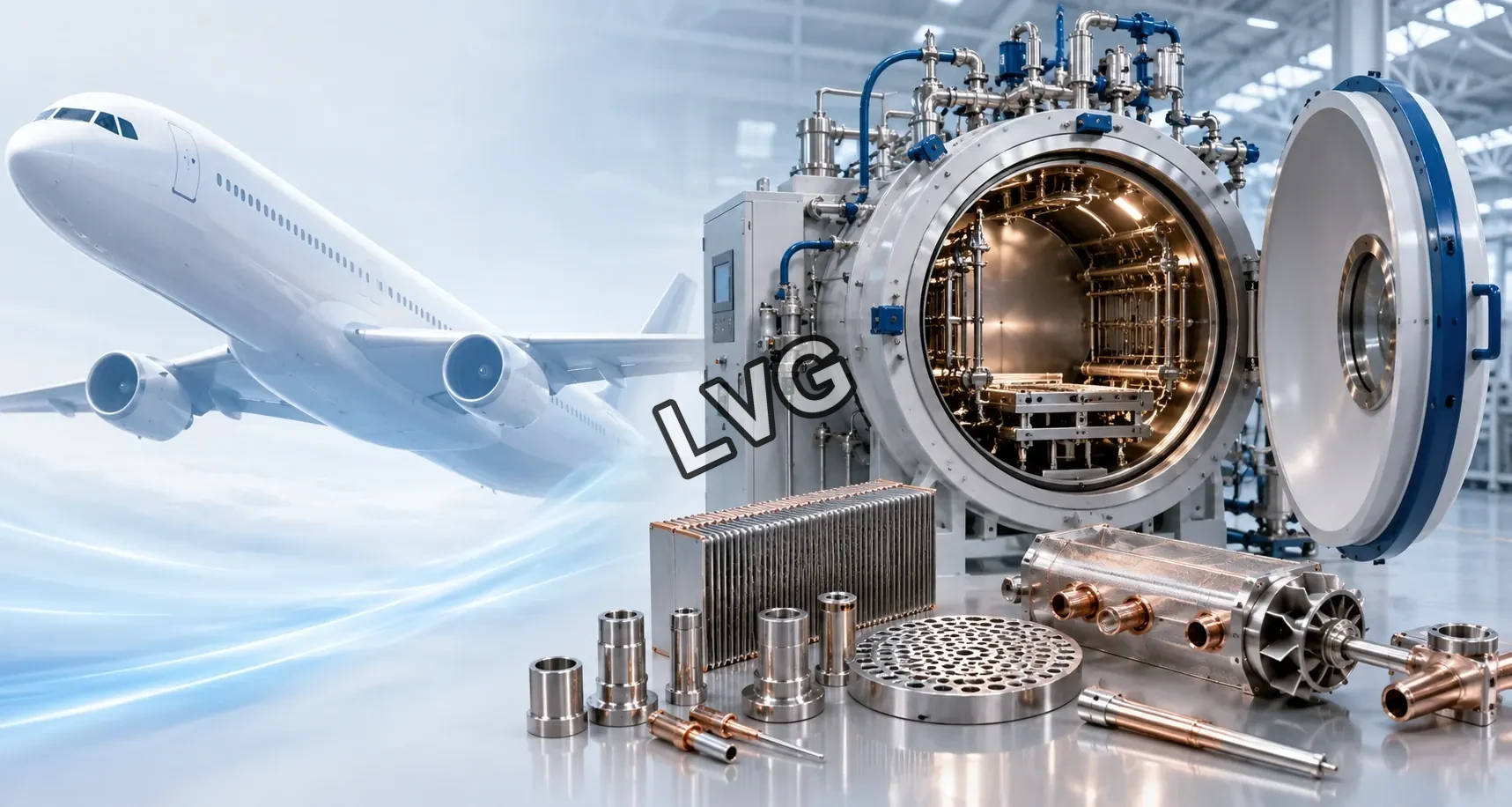
Vacuum Sintering for Porous Metal Filters
Porous metal filters are sintered from stainless steel (SS316L, SS310) and nickel-based alloy powders to form rigid, porous structures with controlled pore sizes. These filters serve critical applications in aerospace, pharmaceutical, chemical processing and semiconductor gas filtration — where pore integrity, oxidation-free surfaces and precise permeability are non-negotiable.
The Industry: Sintered Metal Filters
Sintered metal filters are manufactured by compacting metal powder into the desired shape and sintering it at high temperature — typically 1100°C to 1350°C for stainless steel grades. The sintering process bonds the powder particles at their contact points without melting them, creating a porous yet mechanically strong structure. The pore size (typically 0.1 to 100 microns) is controlled by the initial powder particle size and the sintering parameters.
Vacuum sintering is the preferred method because it prevents oxidation of the stainless steel or nickel alloy surfaces during the high-temperature cycle, ensuring clean pore walls and consistent permeability. Atmosphere sintering in hydrogen or dissociated ammonia is also used, but vacuum offers superior cleanliness and eliminates the safety risks of flammable process gases.
Hydraulic and fuel system filtration where contamination means failure
Sterile gas and liquid filtration in GMP-regulated environments
Corrosion-resistant filter elements for aggressive media
Ultra-clean gas filtration for semiconductor manufacturing
The Technical Challenge
Sintering porous metal filters demands precise control over three critical parameters simultaneously:
- Temperature uniformity: ±5°C across the entire load is essential. Uneven temperature causes differential sintering — some pores collapse while others remain too open — destroying permeability consistency.
- Oxidation prevention: Stainless steel powders oxidise rapidly above 800°C if any oxygen is present. Oxide layers on pore walls reduce filter efficiency and can contaminate the filtered fluid.
- Pore integrity: The sintering window is narrow. Under-sintering gives weak bonds and poor mechanical strength. Over-sintering collapses pores and reduces permeability. The process must hold the temperature in the sweet spot.
- Geometry stability: Filters are often cylindrical or tubular. Bottom-loading furnaces allow vertical stacking, using gravity to maintain shape during the cycle. Top-loading can cause distortion under the weight of stacked parts.
- Batch flexibility: Filter manufacturers run multiple geometries and alloy grades. The furnace must accommodate different batch sizes without re-engineering the fixture for each run.
The Solution: BLVSF Bottom-Loading Vacuum Sintering Furnace
The BLVSF Series Bottom-Loading Vacuum Sintering Furnace is engineered specifically for porous metal and powder metallurgy parts that require vertical stacking, precise temperature uniformity and oxidation-free sintering.
Technical Insight: Why Vacuum Sintering for Metal Filters
The sintering process for porous metal filters is fundamentally different from sintering dense PM parts. In dense parts, you want maximum densification — closing all porosity. In filters, you want controlled porosity — bonding the particles without closing the inter-particle channels that create the filtration path.
- Vacuum removes oxygen and moisture from the chamber before heating begins, preventing oxide formation on pore walls throughout the cycle
- Solid-state diffusion bonds particles at their necks without liquefaction — the particle shape is preserved, maintaining the pore network
- Controlled cooling rate affects final pore size — slower cooling allows some grain growth and neck thickening, which can be tuned to the target pore specification
- Vacuum or inert-gas atmosphere ensures clean, bright surfaces with no post-process pickling or cleaning needed
- Bottom-loading allows gravity-assisted stacking of cylindrical filter elements, maintaining concentricity and preventing warping
Industry Context: Why This Matters
The global sintered metal filter market is growing steadily, driven by demand from semiconductor manufacturing (where ultra-pure gas filtration is critical), biopharmaceutical production (where single-use and reusable sterile filters are expanding), and hydrogen energy (where sintered metal filters are used in fuel cell and electrolyser systems).
India's pharmaceutical sector — one of the largest in the world — is a major consumer of sintered metal filters for sterile gas and liquid filtration. The India Semiconductor Mission is attracting fab investment, which will drive demand for ultra-high-purity gas filtration components. Both trends point to growing demand for vacuum sintering capacity for porous metal parts.
Process Outcomes
When the BLVSF furnace is configured correctly for porous metal filter sintering, the outcomes are measurable and repeatable:
- Uniform pore structure across all sintered parts in the load — verified by bubble-point testing and permeability measurement
- Controlled densification without pore blockage — typically 70–90% theoretical density for filter-grade parts
- Consistent geometry and mechanical strength — parts maintain dimensional tolerances without post-sinter machining
- No discoloration or oxidation on any part — bright, clean surfaces that meet pharma and semiconductor cleanliness standards
- Recipe-based process control with full data logging — every cycle is traceable, which is essential for GMP and aerospace quality audits
Why Bottom-Loading Matters for Filters
Gravity-assisted stackingVertical loading keeps cylindrical filter elements concentric during the entire cycle
Even heatingBottom-loading design ensures uniform radiant heat distribution across stacked parts
Atmosphere flexibilityVacuum, argon or nitrogen — configurable for SS316L, nickel alloys and other grades
Full traceabilityPLC/SCADA recipe logging gives batch records that pharma and aerospace auditors require
ReliabilityDesigned for continuous production with minimal maintenance — proven in industrial sintering operations
Why Lakshmi Vacuum?
- Deep experience in PM part and porous metal sintering — not a general-purpose furnace builder
- Specialised in bottom-loading vacuum systems designed for vertical stacking and geometry stability
- Turnkey support: design → manufacturing → installation → training → AMC → spares
- In-house metallurgy and process development — we help you tune the sintering recipe for your alloy and pore spec
- 450+ furnaces delivered since 2003 to customers in 9 countries, including aerospace and pharma supply chains
For full specifications of the BLVSF series, see our Vacuum Sintering Furnace product page or request a quotation.
Conclusion
Porous metal filters are a growing application for vacuum sintering, driven by demand from pharmaceutical, semiconductor, aerospace and hydrogen energy sectors. The BLVSF bottom-loading furnace is engineered specifically for this application — vertical stacking for geometry stability, precise temperature uniformity for pore control, and vacuum atmosphere for oxidation-free, clean surfaces. For manufacturers scaling filter production, this is the platform that makes consistent, auditable, high-quality sintering repeatable batch after batch.
Sintering Metal Filters?
Tell us your alloy, pore spec and batch size. We'll configure the right furnace for your filters.
Let's Build Your Furnace
From concept to commissioning — turnkey vacuum sintering solutions for porous metal and PM parts.
Request a Quote