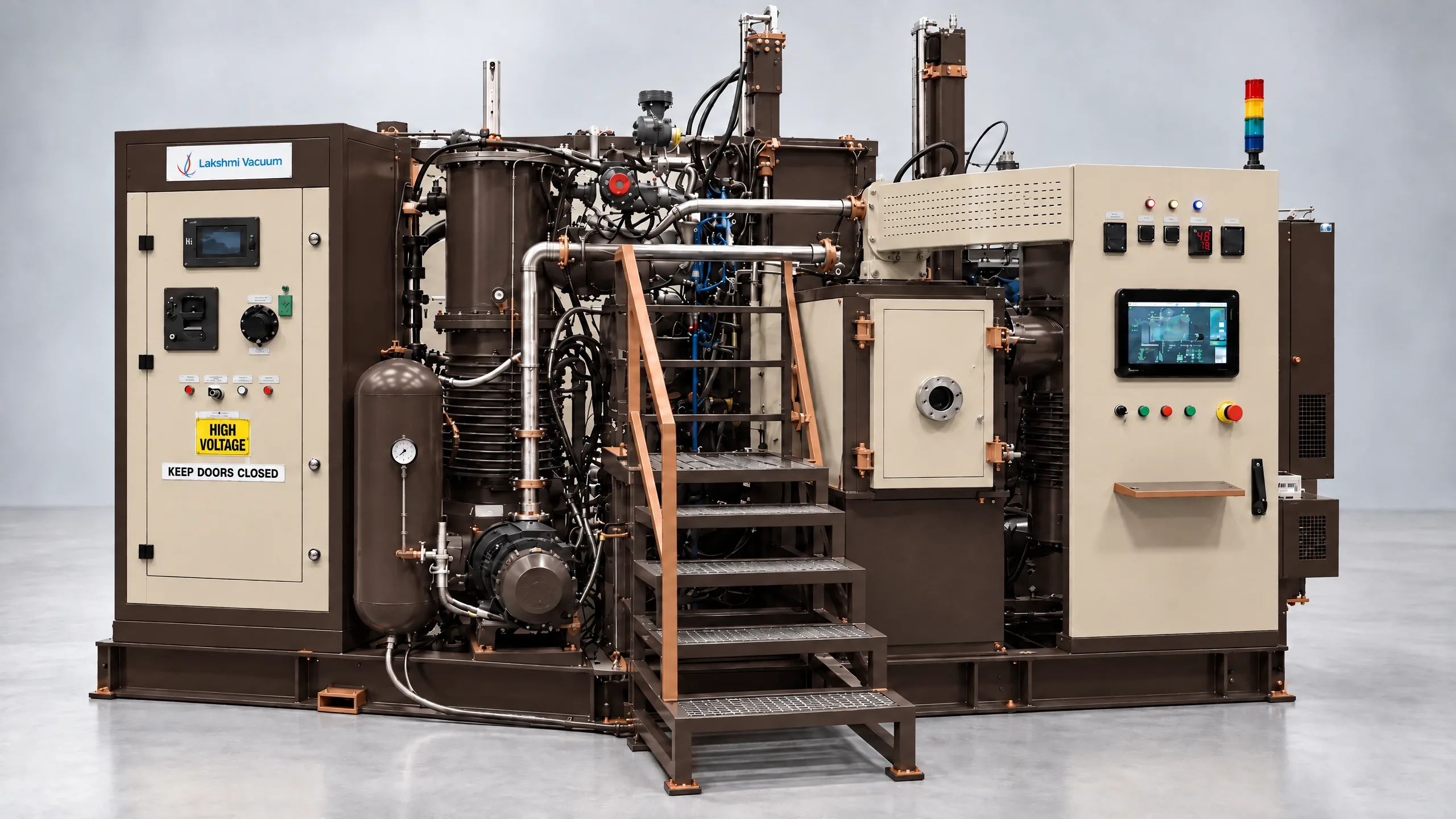
Vacuum Strip Casting Furnace · Overview
Vacuum Strip Casting Furnace for NdFeB and Rare-Earth Alloy Strip
A vacuum strip casting furnace (VIM-SC) melts NdFeB, samarium-cobalt and other rare-earth alloys under vacuum or inert gas and solidifies them against a water-cooled copper wheel into thin, uniform strip. Lakshmi Vacuum Technologies builds these strip casters to order, producing the fine columnar grain structure that high-performance permanent magnets are built on.
Strip casting is the first critical step in permanent-magnet production, serving EV motors, wind turbines, robotics, electronics and aerospace. Because the alloy never meets air, oxygen pickup stays minimal and the strip stays clean; because wheel speed, superheat and flow are controlled recipe by recipe, flake thickness and microstructure stay consistent from heat to heat, with minimal free α-Fe.
Every system is engineered to order: laboratory and pilot casters from 10 kg, production units at 500 kg and beyond, and larger capacities quoted case by case rather than capped by a catalogue limit. Charge weight, wheel diameter and speed, strip width, vacuum level, melt temperature and discharge handling are configured around your alloy and throughput.
Figures are typical for this furnace family and are confirmed against your alloy and process. Charge weight is not capped at 500 kg — larger capacities, strip widths and vacuum levels are engineered to order.
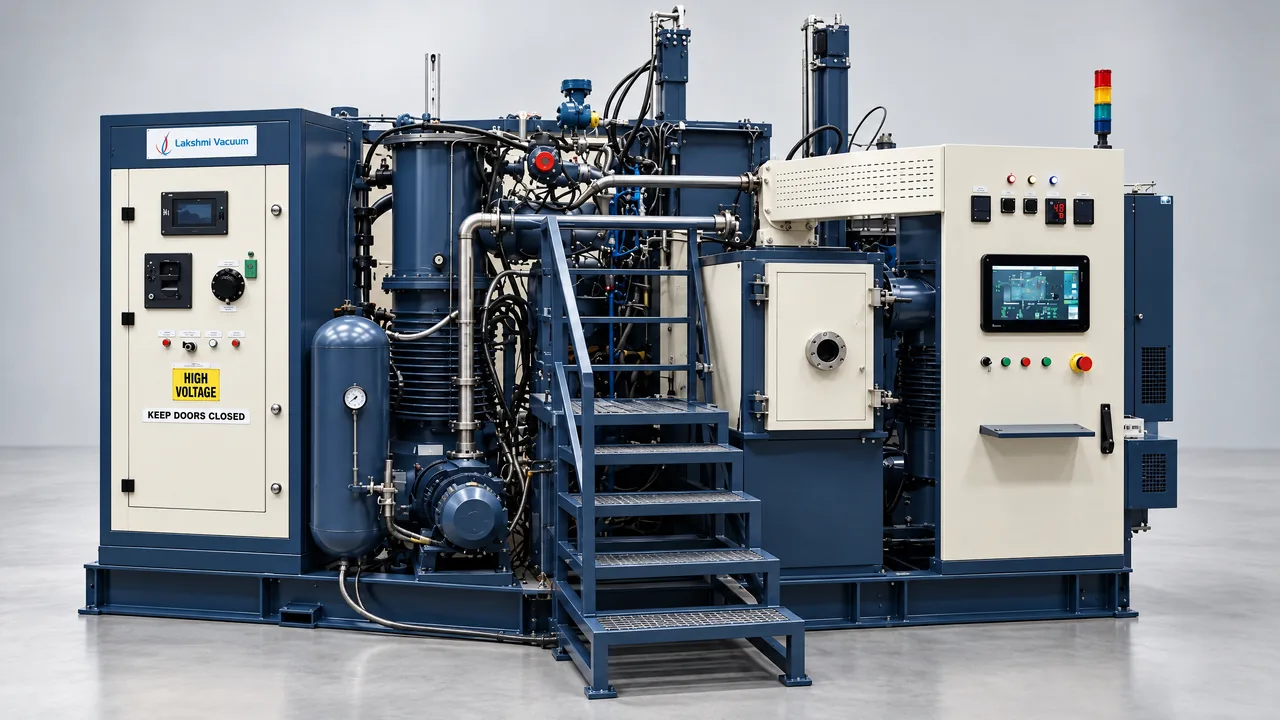 Melt Charge 10 kg & Up · Engineered to Order
Engineering Capability
Strip Casting Technology, Designed and Built In-House
A true vacuum strip casting system combines vacuum induction melting, precise pour control, a water-cooled copper wheel and a sealed strip collection system in one engineered package. Lakshmi Vacuum Technologies designs and manufactures this capability in-house, so every system is configured around the alloy and throughput you actually run.
Magnet manufacturers, rare-earth and alloy producers, EV and wind-energy supply chains, electronics and motor makers, aerospace and defense suppliers, mining and refining operators, and research institutions all use strip casting. Building in-house gives each of them an alternative to imported equipment, with shorter lead times, local service and spares, and engineering support that stays close to your process.
The result is more than a furnace: it is production infrastructure that keeps your rare-earth, magnet and advanced-alloy supply chain secure, uninterrupted and competitive.
Process
How Vacuum Strip Casting Works
Melt Under Vacuum
Alloy is charged into the crucible and induction-melted under high vacuum or inert gas. Reactive rare-earth elements stay clean while oxygen and volatiles are pumped away.
Pour onto the Cooling Wheel
The melt is superheated to a recipe-set temperature and poured through a tundish onto a water-cooled copper wheel spinning at 1–3 m/s. Rapid solidification at 10³ to 10⁵ K/s locks in a fine, columnar microstructure.
Break Out & Discharge
The solidified strip breaks into flakes as it leaves the wheel and drops into a collection chamber — cooled, sealed and ready for hydrogen decrepitation, milling or powder processing.
Why Strip Casting
Strip Casting vs Conventional Ingot Casting
Before strip casting became standard, NdFeB alloy was made by pouring the melt into moulds and letting it cool slowly. The result was a coarse, inhomogeneous ingot with large α-Fe dendrites. Strip casting fixes both problems and is now the industry standard for magnet alloy feedstock.
Conventional ingot casting
- Slow cooling — about 1 to 10 K/s
- Coarse grains with large columnar dendrites
- Soft α-Fe phase forms in the ingot
- Uneven Nd-rich grain boundary distribution
- Hard to powder — needs mechanical crushing first
- Lower coercivity in the final magnet
- More heavy rare earth (Dy, Tb) needed
Vacuum strip casting
- Rapid cooling — 10³ to 10⁵ K/s
- Fine, uniform grains throughout the strip
- Suppressed α-Fe phase
- Even distribution of Nd-rich grain boundary phase
- Easy to powder — direct hydrogen decrepitation
- Higher coercivity and energy density
- Less heavy rare earth for the same coercivity
Value Chain
Where Strip Casting Sits in Magnet Production
Strip casting is one stage in the rare-earth magnet value chain. The strip it produces feeds directly into powder-making, pressing, sintering and ageing — and Lakshmi Vacuum can supply equipment across the full line.
Lakshmi Vacuum
Lakshmi Vacuum
Technical Specifications
Vacuum Strip Casting Furnace Specifications, Sized to Any Capacity
All figures are typical for this furnace family and are confirmed against your alloy and process. Charge weight is not capped at 500 kg — larger capacities, wheel diameters, strip widths and vacuum levels are engineered to order. Send your alloy specification for a configured quotation.
Applications
Strip Casting Applications Across Industries
EV & Wind Turbine Magnets
High-energy NdFeB strip feedstock for the permanent magnets in electric vehicles, traction motors and utility-scale wind turbines.
Electronics, Robotics & Industrial Motors
Strip-cast alloy for the magnets in servo motors, robotics, compressors, hard-disk drives, speakers and consumer electronics.
Bonded Magnets & Powder Feedstock
Coarser-grain flake from slower wheel speeds, milled for HDDR bonded-magnet powder, Metal Injection Molding and additive manufacturing.
Aerospace, Defense & Samarium-Cobalt
Samarium-cobalt and high-temperature magnet alloys where stable performance at heat and tight metallurgical control are critical.
Amorphous & Nanocrystalline Cores
Rapidly solidified soft-magnetic ribbon for transformers, inductors and power electronics, on a dedicated wheel and nozzle configuration.
Rare-Earth Producers & Research Labs
Refiners, alloy producers and mining-linked operations casting Nd, Pr, Dy and Tb metal or master alloy; 10 kg casters for universities and R&D centres.
Why Vacuum Strip Casting
The Case for Casting Strip Under Vacuum
Grain Structure Magnets Need
Rapid solidification on a copper wheel produces thin, uniform flake with fine columnar Nd₂Fe₁₄B grains and minimal free α-Fe, unlike slower book-mould casting.
Wheel Speed & Cooling Rate Under Control
Wheel speed, superheat and flow are held recipe by recipe, so cooling rate stays repeatable from the first flake to the last.
Low Oxygen, Low Loss
Vacuum and inert-gas casting keeps reactive rare earths clean and holds oxygen pickup to a minimum — critical for final magnet density.
From 10 kg Trials to Any Production Scale
One platform scales from laboratory batches to production heats of 500 kg and beyond — larger still on request — with the same recipe control.
FAQs
Frequently Asked Questions
What is a vacuum strip casting furnace?
A vacuum strip casting furnace melts an alloy by induction under vacuum or inert gas, pours it through a tundish onto a water-cooled rotating copper wheel and solidifies it into thin flake. It is the standard first step in NdFeB magnet production and is also used for samarium-cobalt and other rare-earth alloys.
How is strip casting different from book-mould (ingot) casting?
Book-mould casting cools slowly from the mould wall inward, giving coarse grains and more free alpha-iron. Strip casting cools thin flake quickly and evenly at 10³ to 10⁵ K/s, giving a finer microstructure, less α-Fe and a composition closer to target. That is why sintered-magnet makers specify strip-cast alloy.
Which alloys can be cast in this furnace?
NdFeB and Nd-Pr-Fe-B magnet alloys, including grades with Dy or Tb additions, other rare-earth alloys, and samarium-cobalt compositions. Amorphous and nanocrystalline ribbon needs a dedicated wheel and nozzle configuration, which we quote separately.
What charge capacity is available?
From 10 kg laboratory and pilot units upward. Typical production machines run from 100 kg to 500 kg and beyond, and capacity is not capped at 500 kg. Crucible, wheel, pumping set and discharge handling are engineered around your batch size, and larger heats are quoted case by case.
What strip thickness and wheel speed can I expect?
Typical flake thickness is 0.2 to 0.5 mm, with the copper wheel driven by a variable-frequency drive, usually between 1 and 3 m/s. Faster wheel speed gives thinner flake and a finer microstructure; slower speed gives coarser grain, which suits HDDR powder for bonded magnets. Melt superheat and flow rate also matter, so thickness is a process setting rather than a fixed machine limit.
Why cast under vacuum instead of in air?
Rare-earth elements oxidise quickly at melt temperature. Vacuum or inert-gas melting and casting keeps oxygen out of the melt, protects the alloy composition and produces cleaner strip with fewer inclusions, which carries through to magnet density and magnetic performance.
What happens to the strip after casting?
The solidified strip breaks into flakes and cools in a sealed collection chamber. It then typically goes to hydrogen decrepitation and jet milling to make powder, followed by pressing, sintering and heat treatment. The group's vacuum sintering and heat-treatment facilities support those downstream steps.
Can strip casting reduce heavy rare earth use?
Yes. Because strip cast alloy has a more uniform microstructure with suppressed α-Fe, the same coercivity target can often be met with less Dy or Tb than ingot cast alloy would need. Grain boundary diffusion on strip cast alloy magnifies this benefit, reducing heavy rare earth costs.
What decides the price and lead time of a strip casting furnace?
Mainly charge weight, strip width, wheel size and drive, pumping set, induction power, automation level and the vacuum level required. Send your alloy, batch size and target strip thickness and our engineers will size the system and give a configured quotation.
Do you support trials and process development?
Yes. Trial casting and process development can be arranged with our engineers before you specify a system, so wheel speed, superheat and flow are proven on your alloy.
Still have questions? Talk to our engineers or request a quotation.
Related Equipment
Explore Other Vacuum Furnace Systems
Ready to Specify Your Strip Casting Furnace?
Send us your alloy, target strip thickness and batch size — our engineers will size the crucible, wheel and pumping set around your process and support you from first trial to commissioning.