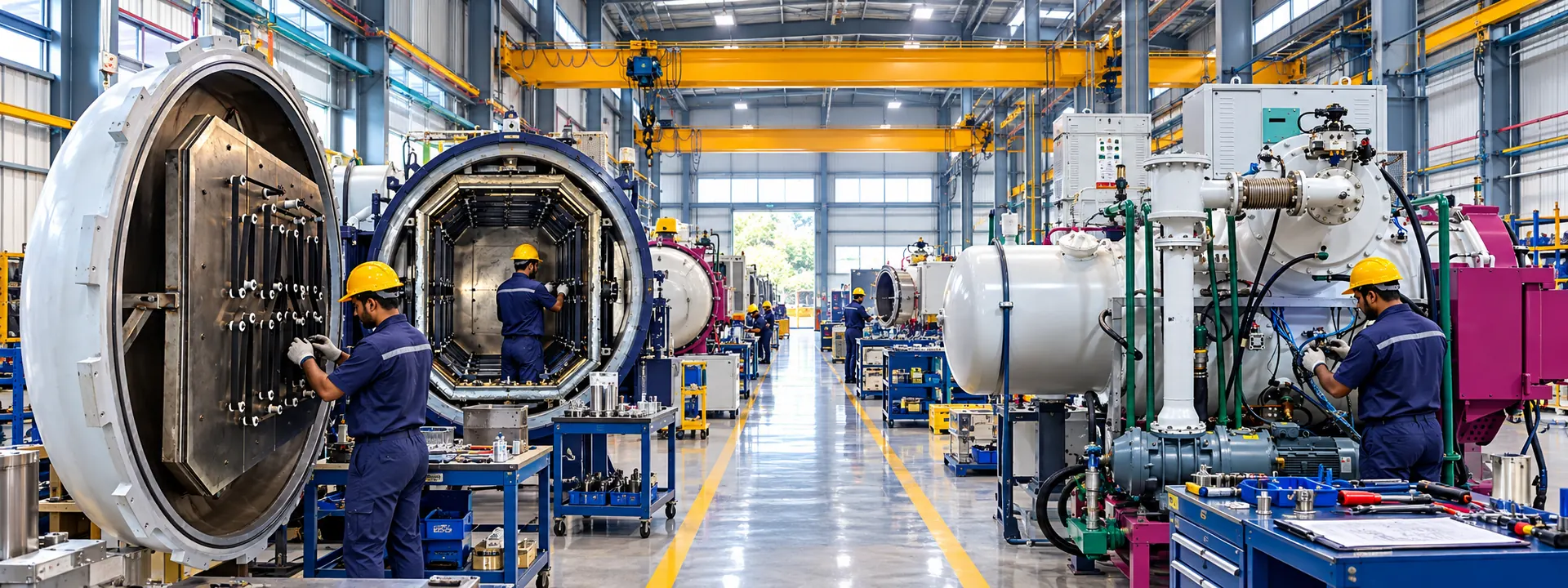
Pack Aluminizing Furnace · Overview
Coatings That Survive the Hot Zone
Lakshmi Vacuum Technologies builds high-temperature pack aluminizing furnaces for diffusion aluminide coatings on turbine blades, vanes, exhaust parts and other hot-section components. The coating is grown into the metal rather than sprayed onto it, so it cannot flake off in service.
Parts are sealed in a retort with an aluminium powder pack, an activator and an inert filler, then heated to 1150°C. Aluminium vapour diffuses into the surface and forms a protective aluminide layer that resists oxidation and hot corrosion at temperatures where an uncoated alloy would scale away.
Uniformity is the whole game: ±5°C across the hot zone keeps coating depth consistent across a batch. Chamber size, heating elements and retort design are configured to your parts at our Bengaluru works.
 Chamber size to order · ±5°C uniformity
Process
How Pack Aluminizing Works
Pack & Seal the Retort
Parts go into a sealed retort with the aluminium powder pack, activator and inert filler. The retort keeps the pack chemistry stable through the whole cycle.
Heat to 1150°C
Electric Kanthal, MoSi₂ or SiC elements bring the chamber up and hold ±5°C across the hot zone, so the aluminium vapour forms at an even rate over every part.
Diffuse & Unpack
Aluminium diffuses into the surface to grow the aluminide layer. On cooling the pack is broken out and the parts go forward to inspection and, where required, heat treatment.
Technical Specifications
Built to Your Parts, Held to ±5°C
Chamber dimensions, heating elements and retort design are configured to your coating requirement. Send your part drawings for a configured quotation.
Applications
Where These Coatings Are Used
Turbine Hot-Section Parts
Aluminide coatings that protect blades, vanes and combustor parts from oxidation and hot corrosion.
Exhaust & Turbo Components
Coating of exhaust components exposed to extreme temperatures and corrosive gases.
Gas Turbine & Energy Plant
Parts that need extended service life at high temperature, without spalling coatings.
Aerospace Flight Hardware
Diffusion coatings for flight parts in high-temperature zones, processed with documented control.
High-Temperature Process Equipment
Protection for components that see oxidation every cycle in process environments.
Heat-Transfer Equipment
Oxidation-resistant coatings for high-temperature heat exchangers and ducting.
Why Pack Aluminizing
The Case for Diffusion Coatings
±5°C Across the Zone
Coating depth follows temperature, so an even hot zone gives an even aluminide layer across the whole batch.
A Layer, Not a Paint
Pack cementation diffuses aluminium into the metal, so the aluminide cannot flake or spall like a sprayed coating.
Retort-Protected Chemistry
A sealed alloy retort holds the pack composition stable, so the same recipe gives the same coating load after load.
Built for 1150°C Duty
Kanthal, MoSi₂ or SiC elements with ceramic-fibre insulation keep the chamber at temperature without chasing the setpoint.
FAQs
Frequently Asked Questions
What is pack aluminizing?
Pack aluminizing (pack cementation) buries the part in a powder pack of aluminium, an activator and an inert filler inside a sealed retort. At temperature the aluminium forms a vapour that diffuses into the surface, growing an aluminide layer that is part of the metal, not a coating sitting on top of it.
What does the coating protect against?
High-temperature oxidation and hot corrosion. Aluminide layers form a protective alumina scale that keeps the base alloy intact at temperatures where an uncoated surface would scale away - which is why turbine blades, vanes and exhaust parts carry them.
What temperature uniformity do your furnaces provide?
±5°C across the hot zone. That matters because coating thickness is driven by temperature: uneven heat gives uneven aluminide depth and inconsistent service life across a batch.
Which industries use pack aluminizing furnaces?
Gas turbines and energy plant, aerospace flight hardware, automotive exhaust and turbo components, and high-temperature process equipment where oxidation resistance decides service life.
How is the process controlled?
A PLC with HMI runs the thermal profile and logs it, so each load is repeatable and traceable. Chamber size, heating elements and retort design are configured to your parts.
Which atmosphere does the furnace run in?
Air is the standard atmosphere for a sealed-retort pack process; inert gas is available as an option where the retort or the part specification calls for it.
Still have questions? Talk to our engineers or request a quotation.
Related Equipment
Explore Other Vacuum Furnace Systems
Ready to Specify Your Aluminizing Furnace?
Send us the parts, the base alloy and the coating depth you need — our engineers will size the chamber, elements and retort around your process.