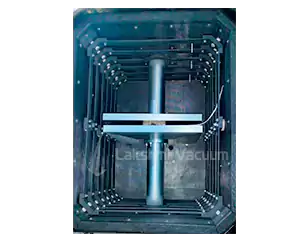
Diffusion bonding is a solid-state joining process in which two surfaces are held together at elevated temperature under vacuum and pressure until atoms diffuse across the interface, forming a joint without melting and without filler metal. The result is a parent-metal-strength joint with no porosity, no flux and no dissimilar filler to corrode.
Lakshmi Vacuum Technologies manufactures vacuum diffusion bonding furnaces and hot presses that combine high temperature (up to 2200°C), precise uniaxial pressure (up to 100 tons) and a contaminant-free vacuum of 10⁻³–10⁻⁵ mbar to make the process repeatable at production scale.
They are used to bond titanium and titanium alloys, nickel superalloys, stainless steel, copper and dissimilar-metal combinations — including titanium-to-steel and ceramic-to-metal joints with an interlayer.
Diffusion bonding is used for aerospace structures and SPF/DB (superplastic forming / diffusion bonding) parts, titanium heat exchangers, micro-channel coolers, turbine and engine components, medical implants, vacuum components and dissimilar-metal assemblies where welding is not possible.
| # | Parameter | Technical Details |
|---|---|---|
| 1 | Max Temperature | Up to 2200°C (graphite / molybdenum heaters) |
| 2 | Max Pressure | Up to 100 tons (uniaxial hydraulic) |
| 3 | Heating Zone Size | Ø100 – Ø600 mm (custom available) |
| 4 | Vacuum Level | 10⁻³ – 10⁻⁵ mbar |
| 5 | Atmosphere | Vacuum / Inert gas (Argon, Nitrogen) |
| 6 | Heating Type | Resistance heating with multi-zone control |
| 7 | Control System | PLC, IPC with SCADA, DAS optional |
| 8 | Cooling System | Water-cooled components; controlled cooling |
| 9 | Bonded Materials | Titanium, nickel superalloys, stainless steel, copper |
| 10 | Applications | SPF/DB structures, heat exchangers, micro-channels |
A solid-state joining process in which two surfaces are pressed together at elevated temperature (typically 0.5–0.8 of the absolute melting point) under vacuum, so atoms diffuse across the interface and create a joint without melting and without filler metal.
A vacuum removes the oxygen and moisture that would form oxide films on the bonding surfaces, enabling clean metal-to-metal contact. It also prevents contamination of reactive alloys such as titanium and nickel superalloys at bonding temperature.
Titanium and titanium alloys, nickel superalloys, stainless steels, copper and copper alloys, refractory metals and many dissimilar-metal combinations — including titanium-to-steel and copper-to-ceramic joints with an interlayer.
Share your material pair and joint geometry — our engineers will recommend the temperature, pressure and dwell cycle and the right furnace configuration.
Speak to Expert