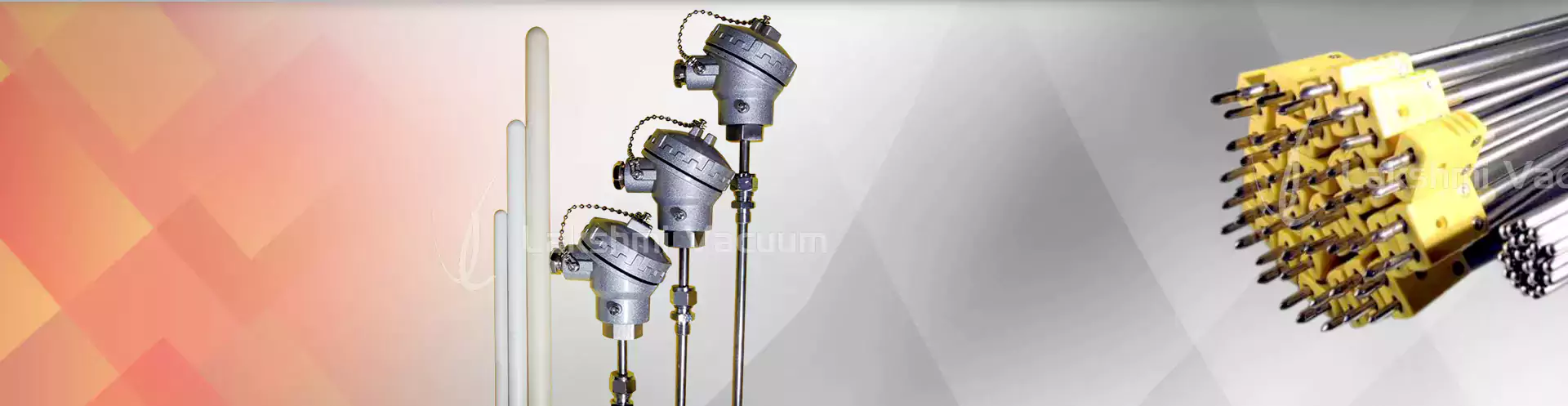
A Thermocouple Theory
A thermocouple is an electrical device consisting of two dissimilar electrical conductors forming electrical junctions at differing temperatures.
A thermocouple produces a temperature-dependent voltage as a result of the thermoelectric effect, and this voltage can be interpreted to measure temperature. Thermocouples are a widely used type of temperature sensor.
In 1821, the German physicist Thomas Johann Seebeck discovered that when different metals are joined at the ends and there is a temperature difference between the joints, a magnetic field is observed.
At the time, Seebeck referred to this consequence as thermo-magnetism. The magnetic field he observed was later shown to be due to thermo-electric current.
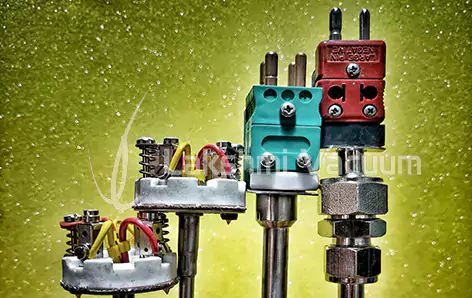
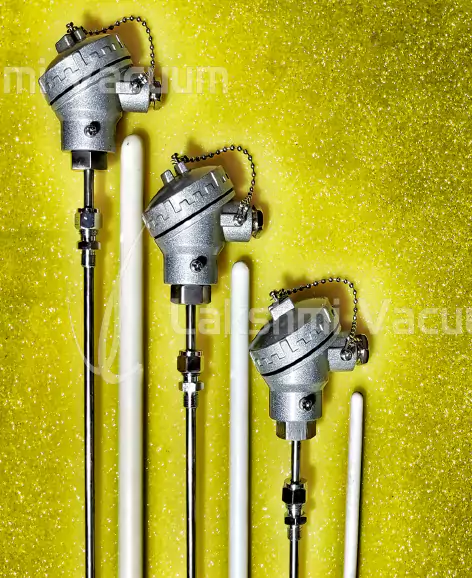
Thermocouple Range
Four specialized families engineered for every industrial temperature regime.
Base Metal Thermocouples
These thermocouples use base metal wire insulated in a 2-hole or 4-hole insulator and outer metal tubes like SS 304, 316, 310, 446 varieties, Inconel 600, 800 and ceramic tubes.
Noble Metal Thermocouples
These thermocouples are suitable for high temperatures, Types R, S & B, with sillimanite and recrystillized alumina tubes. Maximum temperature 1800°C.
Special Purpose Coated Thermocouples
Available with special outer tubes like zirconia, graphite, silicon carbide graphite for non-ferrous molten metals.
Washer Type Thermocouples
For effective measurement of temperature on non-accessible locations, screw type. Maximum useful temperature up to 400°C.
Thermocouple Types at a Glance
A quick comparison of the families we build — and the cables that carry the signal back to your controller.
Customization & Support
We offer fully customizable thermocouple configurations to meet your exact needs – from size and loading systems to automation and control software. Our team is also available for installation, training, and ongoing support to keep your operations running smoothly.
Custom Specifications
Tailored thermocouple designs to match your exact temperature range, environment, and mounting requirements.
Prompt Delivery
Efficient production and logistics to ensure your thermocouples reach you on schedule, every time.
Technical Support
Expert guidance on selection, installation, calibration, and troubleshooting from our experienced team.
Why Thermocouple Accuracy Decides Your Cycle
Every vacuum heat treatment cycle is only as good as the temperature the controller believes it is seeing. A thermocouple that drifts, responds slowly or was specified for the wrong range does not announce itself — it quietly shifts hardness spread, case depth and repeatability until parts start failing inspection and batches are scrapped for a reason nobody can find.
Lakshmi Vacuum's thermocouple division exists for exactly that reason. We manufacture the sensors that run inside our own vacuum furnaces, and supply the same range for industrial heat processes where accurate, repeatable temperature measurement is the difference between a stable process and a scrap bin.
The range covers base metal thermocouples for everyday furnace duty, noble metal types for the highest temperatures, coated assemblies for aggressive environments and washer types for surfaces a probe cannot reach — together with the RTDs, compensation cables, connectors and colour codes that complete the measurement loop.
Where Our Thermocouples Are Used
From our own furnace hot zones to molten-metal and laboratory work, the same range covers the measurement points that decide process quality.
Vacuum Furnaces & Vacuum Heat Treatment
Hot zone, workload and quench-chamber measurement for brazing, hardening, tempering, annealing and sintering cycles.
Sintering & High-Temperature Processes
Noble metal types in sillimanite and recrystallised alumina protection tubes for the upper temperature range, up to 1800 °C.
Non-Ferrous Molten Metals
Coated assemblies with zirconia, graphite or silicon-carbide graphite outer tubes for molten non-ferrous metal measurement.
Atmosphere & Case-Hardening Furnaces
Sensors for carburising, nitriding and atmosphere furnaces, where the probe has to survive a reactive environment as well as the temperature.
R&D, Pilot & Laboratory Furnaces
Small-batch and special assemblies for experimental cycles, built to the drawing or the mounting the trial demands.
Industrial Heat & Process Plant
Rugged, replaceable probes for kilns, ovens, heat exchangers and process equipment that runs continuously.
Building a Thermocouple Specification
Six parameters decide whether a thermocouple measures well or merely measures. Tell us the cycle and the furnace, and our team will put the specification together with you.
Type
Base metal thermocouples for general furnace duty, or noble metal Types R, S and B where the process runs into the highest temperature range.
Temperature range
Match the sensor to the peak the process reaches, not the average it sits at — base metal for everyday cycles, noble metal for the top end, washer types where the measuring point is a surface rather than a chamber.
Sheath & protection tube
Stainless steel 304, 316, 310 or 446, Inconel 600 and 800, or ceramic tubes — and zirconia, graphite or silicon-carbide graphite where molten non-ferrous metal is involved.
Insulation & construction
2-hole or 4-hole insulators and, for high-temperature assemblies, sillimanite and recrystallised alumina tubes that hold their shape through repeated cycles.
Mounting & junction
Standard probes for hot-zone and workload measurement, and screw or washer types for surfaces that cannot take a probe, rated for the lower-temperature measuring points.
Length, termination & accessories
Immersion length matched to your hot zone, the connector that fits your panel, and the matching compensation cable, RTD or colour-code reference so the whole loop is consistent.
Thermocouple Division — Frequently Asked Questions
Which thermocouples does Lakshmi Vacuum supply?
Base metal thermocouples, noble metal Types R, S and B, special-purpose coated thermocouples and washer-type thermocouples — along with RTDs, compensation cables, connectors and colour-code references.
How do I choose between base metal and noble metal?
It comes down to the peak temperature and the environment. Base metal covers everyday furnace duty; noble metal is for the upper range, used with the right protection tube. Tell us your cycle and the atmosphere, and our team will recommend the type, tube and length.
Can you build a thermocouple to my drawing or required length?
Yes. Assemblies are fully customisable — type, protection tube, insulator, immersion length, mounting and termination are configured to your furnace and your measuring point.
Do you supply cables, connectors and the associated references?
Yes. Compensation cables, connectors, RTDs and colour-code references are part of the same division, so the sensor and everything behind it come from one source.
How do I request a quotation?
Share the application or thermocouple type, the temperature range, protection tube, immersion length, quantity and when you need it. Contact us or submit an RFQ and the team will come back with the specification and pricing.
Where are the thermocouples made, and do you supply across India?
They are manufactured at our Bengaluru facility and supported by the same service network that covers 9+ Indian locations, so replacements and spares reach your plant without a long supply chain.
Explore the Thermocouple Range
Connection & Configuration
Junction types, terminations and mounting configurations explained.
View pageThermocouple Cables
Compensation and extension cables that keep the signal accurate to the controller.
View cablesRTDs
Resistance temperature detectors for lower-temperature, high-accuracy measurement points.
View RTDsAlso useful: thermocouple colour codes for wiring reference, and our vacuum furnace range if the sensor is part of a larger furnace project. Ready to specify? Submit an RFQ or contact the team.