
Why Configuration Decides Signal Integrity
In high-precision thermal processing, a thermocouple or RTD is only as accurate as its connection. A poorly specified plug, an ungrounded junction in a noisy environment, or a 2-wire RTD on a long run will introduce resistance and electrical noise that shifts your controller readings.
At Lakshmi Vacuum, we configure sensors based on the environment, the distance to the controller, and the required response time. From heavy-duty industrial plugs to high-precision 4-wire RTD setups, we ensure the signal leaving the hot zone arrives at the PLC without distortion. Pair the right connector with the correct thermocouple color code and matching RTD wiring, and the loop reads true from hot zone to PLC.
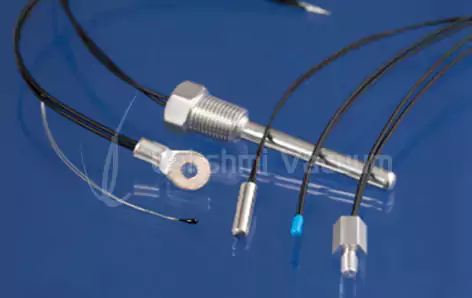
Industrial Connection Types
Pin profile for panel density, screw terminals for vibration, terminal heads for protection — the plug follows the duty of the installation.
Standard Plugs
The industry standard for general furnace duty. Uses flat-pin polarity to prevent reverse wiring. Ideal for reliable, everyday connections where vibration is minimal.
General PurposeMiniature Plugs
Designed for space-constrained installations and multi-point probes. Smaller pin profile allows for high-density wiring in tight panels or within furnace control boxes.
Compact SpacesHeavy-Duty / Screw Type
Built for harsh environments with high vibration or physical impact. Uses threaded screw terminals to lock wires in place, ensuring the connection never loosens during a cycle.
High VibrationTerminal Heads
Enclosed metal or plastic housings that protect the sensor-to-cable transition point. Provides a secure, organized junction block for DIN-rail transmitters or extensions.
Industrial ProtectionMulti-Point Probes
Configurations featuring multiple thermocouples within a single sheath, connecting to a multi-pin plug. Ideal for measuring temperature gradients across a workload.
Gradient MappingRTD Wire Configurations
The number of wires in an RTD determines how accurately the controller can compensate for lead wire resistance.
2-Wire RTD
The simplest configuration. The same two wires carry the excitation current and measure the resistance. Lead wire resistance is added to the measurement, causing slight errors.
Short Distances Only3-Wire RTD (Industry Standard)
The most common industrial setup. The third wire measures the lead resistance and subtracts it from the total, compensating for distance. Highly accurate for most furnace applications.
Best Value / Standard4-Wire RTD (High Precision)
The ultimate in accuracy. Two wires carry the current, and two separate wires measure the voltage drop, completely eliminating lead wire resistance. Used in labs and aerospace cycles.
Maximum AccuracyThermocouple Junction Types
How the two dissimilar metals are joined at the tip determines the sensor's response time and its resistance to electrical noise.
Exposed Junction
The fastest response time, as the wires are physically exposed to the environment. Used for non-corrosive, low-pressure applications where speed is critical.
Fastest ResponseGrounded Junction
The wires are welded directly to the protective sheath. Provides fast response and excellent heat transfer, but can pick up electrical noise if the furnace isn't properly grounded.
Fast & DurableUngrounded Junction
The wires are welded and insulated from the protective sheath. Slightly slower response time, but completely isolates the sensor from electrical noise. Ideal for sensitive PLCs.
Noise IsolationFrequently Asked Questions
When is a 2-wire RTD still acceptable?
Only where cable runs are very short — roughly a few metres — and the small lead-resistance offset can be trimmed out at the instrument. For longer runs, a 3-wire RTD subtracts lead resistance and is the industrial default for furnace work.
Should a vacuum furnace use a grounded or ungrounded junction?
Ungrounded in most cases: the junction stays isolated from the sheath, so the controller is protected from ground loops and electrical noise. Grounded junctions respond a few seconds faster but suit cycles where noise is already managed.
Can I extend a thermocouple with ordinary copper cable?
No. Copper forms an extra dissimilar-metal junction that drifts with ambient temperature. Always run matching extension or compensating cable of the correct color code between sensor and instrument.
Which connection type suits a vibrating furnace or tray?
Heavy-duty screw-type plugs or terminal heads, where threaded terminals lock the conductors in place. Miniature flat-pin plugs suit dense control panels, while standard plugs remain fine for low-vibration, everyday duty.
Need Help Specifying Your Connection?
Our experts will help you determine the right plug, wire configuration, and junction type to ensure signal integrity for your specific thermal cycle.