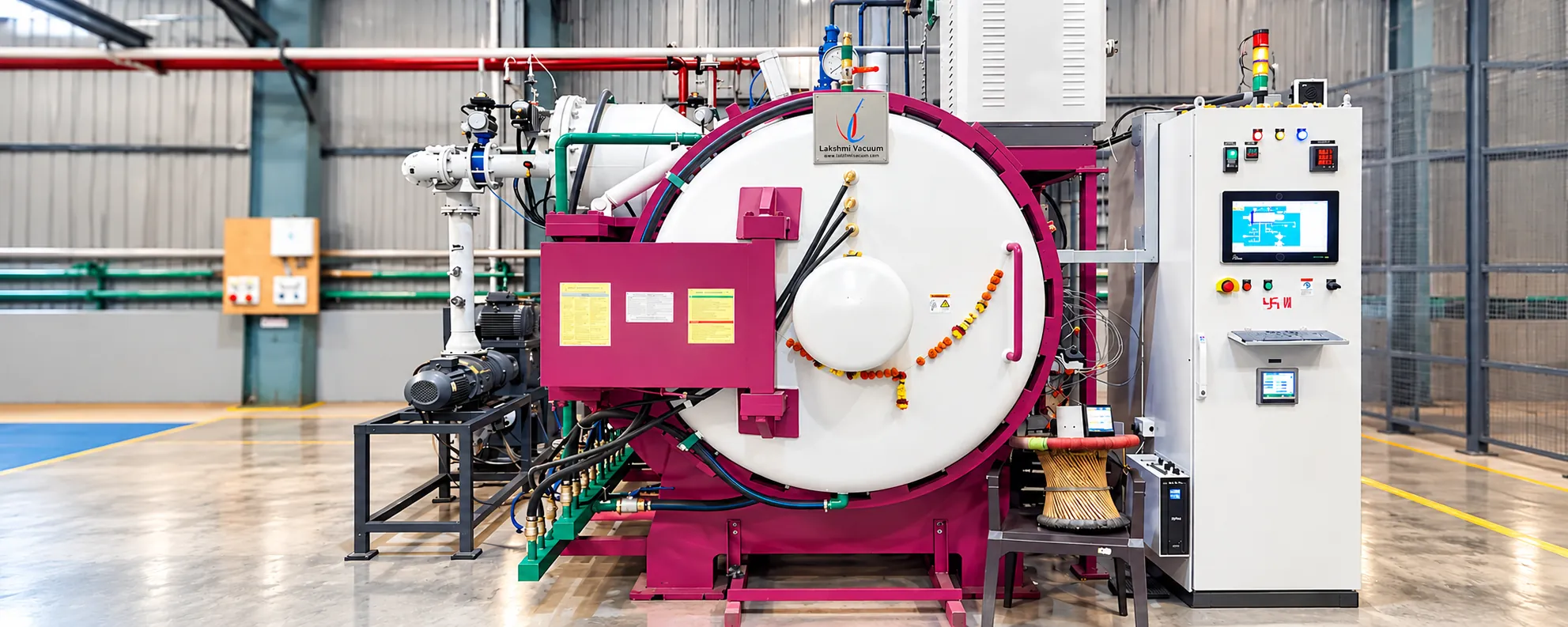
Most vacuum furnace enquiries reach us in one line: “Please send a quotation for a vacuum furnace.” Our first question back is always the same: what are you putting inside it?
That question is not a formality. A furnace that is perfect for hardening tool steels can be the wrong machine for sintering. A furnace that suits brazing may disappoint you on titanium. Size and price matter, but they come second. Your process comes first.
This guide is how we think about the choice. We build vacuum furnaces in Bengaluru, and we also run vacuum heat treatment across 9 centres in India, so we see both sides: how a furnace is built, and how it behaves on a production floor every day.
A vacuum furnace stays in your plant for years, so a wrong selection stays with you too. Below we show where selections go wrong, what that costs you, and how we stand beside you so it does not happen.
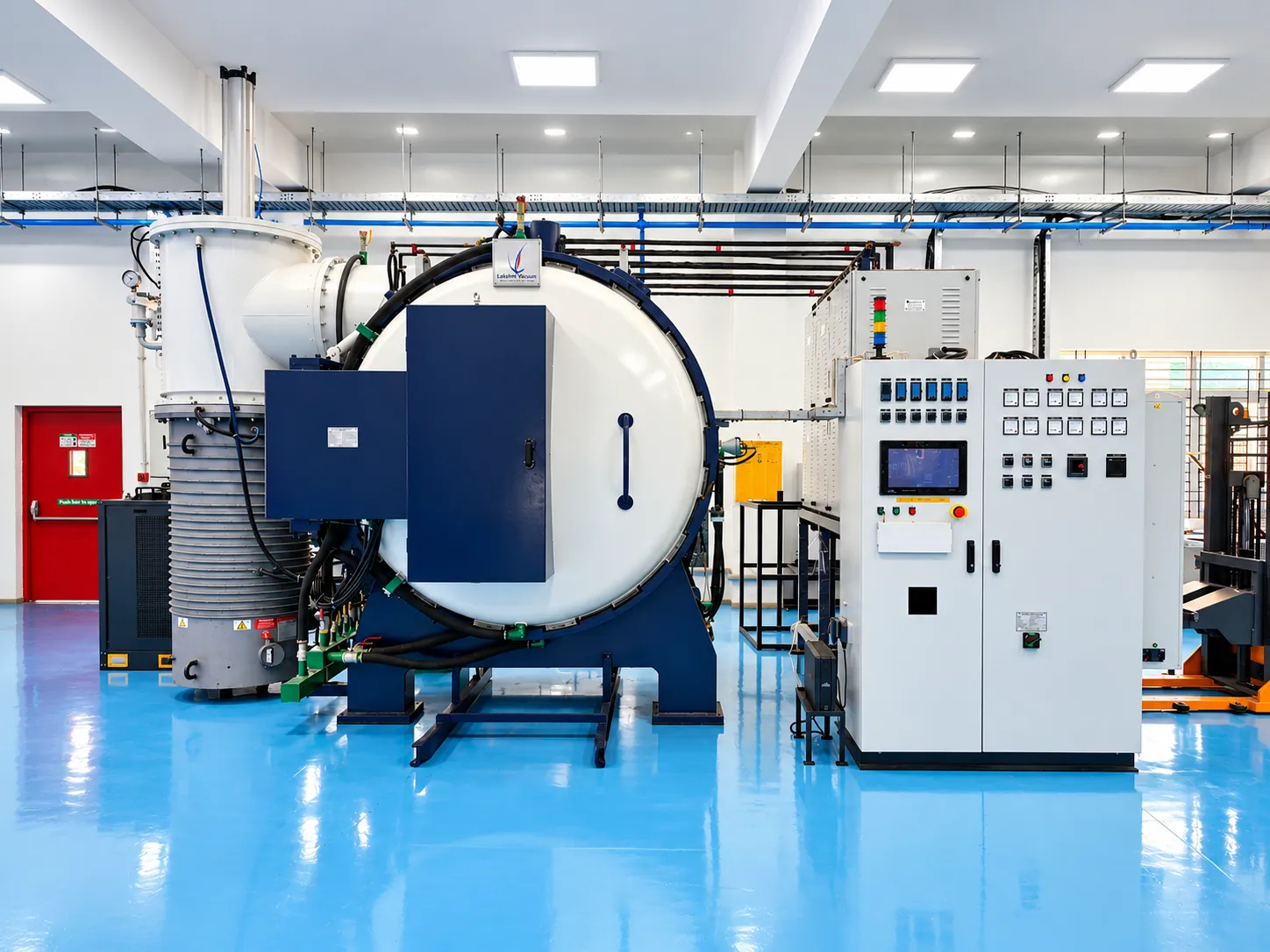
What a wrong selection really costs you
A wrong selection rarely shows up on day one. It shows up three months later as rework, delays or a customer complaint, and by then the furnace is already installed. These are the problems that follow when a furnace is chosen on size and price alone.
| If the wrong furnace is chosen | What you see on the floor | What it costs you |
|---|---|---|
| Working zone too small | Batches queue up and parts go back to outside job-work | Lost output, and a second furnace sooner than planned |
| Working zone too large | Long pump-down and heat-up on part loads, high running cost per part | Higher cost on every batch for years |
| Wrong cooling method | Hardness not reached, or parts distort | Rejections, rework and extra grinding allowance |
| Hot zone or vacuum level not suited to the material | Discoloured parts, contamination, results that change from batch to batch | Scrap on costly material and unhappy customers |
| Poor temperature uniformity | Parts in one batch heated differently, with uneven hardness or weak joints | Failed inspection and returned parts |
| Controls and records not matched to your audits | The customer audit finds gaps in cycle data | Delayed approvals, lost orders and a costly retrofit |
| No service plan | Weak vacuum, leaks or a worn hot zone, with no one close by to fix it | Production days lost while you wait |
Almost every row above can be avoided at the selection stage, which is why we start there. Which one worries you most? Comment below or tell our team, and we will tell you what to check.
Step 1: Find your process
Read the five lines below and notice which one sounds like your plant. This is the most important choice you will make.
“We harden tool steels, dies and moulds.” You are most likely looking at a vacuum hardening furnace with gas quenching. What to ask: how fast can it cool your steel, how much load can it handle, and how even is the temperature across the whole batch? If chosen wrong: hardness falls short or parts distort, and you pay in rejections and grinding.
“We process aerospace, titanium or high-alloy parts.” Surface quality and process records matter more here than anywhere else. What to ask: how clean is the hot zone, how deep is the vacuum, and what cycle data is recorded for every batch? If chosen wrong: surface contamination or missing cycle records can fail a customer audit on high-value parts.
“We join assemblies by brazing.” Brazing depends on even heating and a clean environment. What to ask: how uniform is the temperature, and how repeatable is the cycle from one batch to the next? If chosen wrong: uneven heating gives weak or incomplete joints that show up only in testing.
“We sinter MIM parts, carbide, ceramics or magnet materials.” Sintering often includes debinding, and each material has its own atmosphere and temperature needs. What to ask: can the furnace handle the debinding and sintering steps for your material, and how is the atmosphere controlled? If chosen wrong: weak atmosphere or debinding control gives results that vary from batch to batch.
“We cast or melt rare earth and special alloys.” This needs a furnace designed for casting, not a heat treatment furnace adapted for the job. Our vacuum strip casting furnace is built for this application. If chosen wrong: a furnace not built for casting cannot give consistent results, and you lose material and time.
Your turn: which letter are you? If you are on LinkedIn, comment your letter below and tell us one thing you wish your current furnace did better. We read every reply.
Step 2: Four questions that shape the furnace
Once the process is clear, four questions fine-tune the choice.
1.
How much do you load, and how big are the parts? This sets the working zone. Too small and you lose output. Too large and you pay to heat space you do not use. Think about the load you expect in two to three years, not only today.
2.
How should the parts cool? Gas quench, oil quench or slow cooling gives very different results in hardness and distortion. This choice depends on your material and the properties you need.
3.
What are your quality requirements? If your customers audit you, or you work to standards such as those in aerospace and automotive, say so at the start. It affects the controls, the records and the furnace class.
4.
Who will look after it? A vacuum furnace is a long-term partner, not a one-time purchase. Pumps, hot zone and seals all need care over the years. We cover this in the next section because it is the one buyers think about last.
How Lakshmi Vacuum supports you, from selection to service
A furnace is not a one-day purchase, and a wrong selection is cheapest to prevent at the start. The support behind the machine also decides how it performs in year five. This is how we stay with you at every stage.
| Stage | What worries you | How we support you |
|---|---|---|
| Selection | Am I choosing the right furnace? | Our application engineers start from your parts, material, batch size and quality needs, and recommend the furnace type and configuration before any quotation. If a smaller furnace or job-work suits you better for now, we say so. |
| Customised design | Will a standard model fit my parts? | We configure the furnace around your process, load and standards, instead of asking you to adapt your parts to a catalogue model. |
| Manufacturing | What is happening to my order? | You are kept informed through manufacture, and our team walks you through the furnace before it leaves our works. |
| Onsite deployment | Will it run properly in my plant? | Our team handles installation and commissioning at your site and brings the furnace to its working vacuum and temperature performance. |
| Training | Will my team know how to run it? | We train your operators and maintenance staff on operation, routine care and troubleshooting. |
| After-sales support | What if something goes wrong? | One team to call for spares, advice and support after handover. |
| Service | Will it still perform in year five? | Hot box relining, vacuum and diffusion pump reconditioning, water circulation system reconditioning, and helium leak detection with leak rate reports, across India and worldwide. |
Whichever supplier you choose, ask them these service questions before you sign:
- Can they reline the hot box and recondition the diffusion pump?
- Can they recondition the water circulation system?
- Can they run helium leak detection and give you a leak rate report?
- Will they come to your plant, wherever it is in India?
Our service team supports vacuum furnaces across India and worldwide, and works on furnaces of all brands, not only ours. Details are on our spares and service page.
The knowledge behind every recommendation
A brochure shows what a machine can do. A heat treatment floor shows what it does after thousands of cycles. Lakshmi Vacuum Group builds vacuum furnaces and also operates vacuum heat treatment centres, so we see which materials, loads and cycles cause trouble. That knowledge goes back into how we design, advise and service.
It also means we will tell you honestly if a smaller furnace, or even job-work for now, is the better choice for your volumes.
Get a furnace recommendation built around your process
A wrong selection is expensive to fix and cheap to avoid. Before you commit, let us check your choice against your process. Send us these six details, and our application engineer will come back with the furnace type, the configuration to consider and the questions worth settling before you decide:
- Material you process (for example, tool steel, titanium, magnet alloy)
- Part size and shape, a drawing or photo if you have one
- Batch weight you want to load
- Process and temperature range
- Cooling requirement, if you know it
- Quality standards you need to meet, and when you plan to buy
Not sure about some of them? Send what you have. Our engineers will fill the gaps in the first conversation.
Already have a quotation from another supplier? Send it along with your details, and we will go through the selection with you: size, cooling, hot zone, controls and service.
How to reach us
Send your details through our request a quote page
Email: marketing@lakshmivacuum.com
Call or WhatsApp: +91 7022038671
Website: www.lakshmivacuum.com
In short
- Start with your process, not the brochure.
- Let load, cooling and quality needs shape the furnace.
- Check service support before you sign.
- Choose a partner who stays with you from selection to service, not only until delivery.
Tell us what you are processing, and we will tell you which vacuum furnace fits.
Let's Work Together
Whether you need a custom vacuum furnace, vacuum heat treatment services, genuine spares, or AMC support — we're ready to help.
Request a Quotation