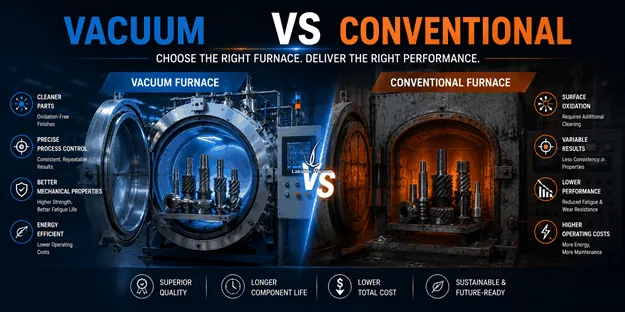
Walk into any precision manufacturing facility after a large batch has come out of the industrial heat treatment process, and you are likely to hear the same frustrations echoing across the shop floor. Parts that left the CNC machine holding exact tolerances are suddenly out of spec. Slight warping, surface discoloration, or unpredictable hardness gradients turn a finished, high-value component into a costly rework project—or worse, scrap.
Heat treatment is not optional. It is the metallurgical backbone of manufacturing. It defines the microstructure and ultimately determines the wear resistance, tensile strength, and fatigue life of a component. But the environment in which that thermal cycle happens often determines whether you get a usable part or a massive bottleneck on your production line.
For manufacturers evaluating an industrial vacuum furnace, the difference between vacuum technology and conventional methods is not theoretical. It directly impacts your scrap rates, machining allowances, and delivery timelines.
Key Advantages of Vacuum Heat Treatment Furnace
- Oxidation-free parts — Prevents scale and oxidation, eliminating post-cleaning
- Uniform cooling — Provides controlled, consistent cooling for complex geometries
- Precise process control — Ensures repeatable temperature and metallurgical results
- Environmentally friendly — No oil or hazardous waste produced
- Enhanced mechanical properties — Achieves high hardness and strength without contamination
- Safer operation — Inert gases reduce fire hazards
- Minimal distortion — Reduces thermal gradients, minimizing warpage
- High-quality surface finish — Maintains pristine surfaces without post-processing
- Process flexibility — Adjustable for different materials and batch sizes
Vacuum vs Conventional Furnaces: Direct Comparison
Vacuum heat treatment is more effective than atmospheric heating because it eliminates the risk of oxidation and surface contamination. The vacuum environment ensures precise temperature control, resulting in better surface quality and consistent material properties without the need for reactive gases.
| Parameter | Atmosphere Heating | Vacuum Heat Treatment |
|---|---|---|
| Furnace Environment | Controlled gases (air, N₂, H₂, etc.) | Low-pressure vacuum, sometimes with inert gases |
| Oxidation Control | Requires controlled atmosphere to prevent oxidation | No oxidation — absence of oxygen |
| Surface Quality | Risk of surface oxidation or scaling | Clean, oxidation-free surfaces |
| Heat Transfer | Convection | Radiation |
| Temperature Uniformity | Moderate (depends on design & gas flow) | High (±6°C even distribution) |
| Gas Composition Control | Crucial for carburizing/nitriding | Minimal, except trace gases like H₂ |
| Material Suitability | Broad range, especially steel & alloys | High-performance (aerospace, medical) |
| Cycle Time | Faster due to gas heating | Slower due to heat-up/cool-down in vacuum |
| Equipment Cost | Less expensive, simpler design | Higher capital investment, complex system |
| Applications | Carburizing, nitriding, annealing, hardening | High-precision parts, aerospace, medical devices |
The Reality of Conventional Furnace Processing
Conventional heat treatment furnaces operate using controlled atmospheres—typically a mix of nitrogen, carbon monoxide, hydrogen, or endothermic carrier gases. The core idea is to displace oxygen to limit oxidation while transferring heat to the workload through convection (blowing hot gas over the parts).
In practice, maintaining a perfectly stable atmospheric chemistry across a multi-hour cycle is incredibly difficult. Gas suppliers fluctuate, humidity changes, and furnace door seals degrade. Even minor variations in the gas composition lead to severe metallurgical consequences:
Furthermore, gas flow inside a conventional furnace creates uneven heating zones. Parts positioned near the gas inlet experience different thermal conditions than those blocked by the workload or tucked in the corners. This leads to inconsistent hardness and microstructures across a single batch.
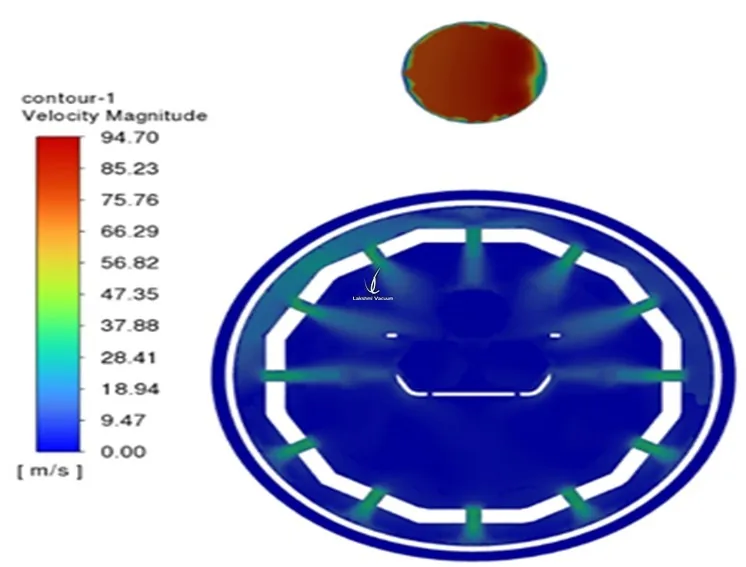
In contrast, the gas flow and cooling pattern inside a vacuum furnace is distributed uniformly across the work zone — improving hardness and microstructure consistency, batch after batch.
How Vacuum Heat Treatment Changes the Physics
Vacuum heat treatment removes the root cause of these issues—the atmosphere itself.
Inside a vacuum furnace, heavy-duty pumping systems evacuate the chamber to very low pressures, often down to 10⁻² mbar. With oxygen, moisture, and reactive gases physically removed, the metal is processed in a chemically pristine environment.
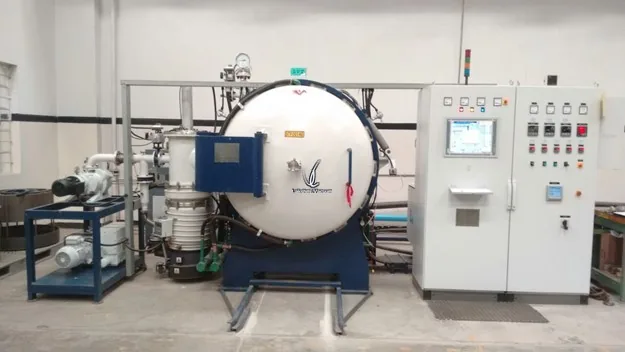
Heat transfer shifts from convection to pure radiation. Heating elements emit infrared energy that is absorbed directly by the workload. This radiant heating is inherently stable and uniform. Modern vacuum furnaces maintain temperature uniformity within ±6°C across the entire hot zone, ensuring every part undergoes the exact same phase transformation.
The most significant leap in vacuum technology is the quenching phase. Instead of dunking a red-hot part into volatile oil or water — which creates chaotic thermal shock — vacuum furnaces use high-pressure inert gas quenching. The chamber is rapidly backfilled with ultra-pure nitrogen or argon (up to 12–15 bar pressure), and high-capacity internal fans circulate the gas at high velocities to cool the parts uniformly from all directions.
Quenching Differences: Oil vs Gas
To appreciate the impact on distortion, you have to look at how quenching actually works.
When a part hits oil or water, the liquid immediately vaporizes around the hot metal, forming a "vapor blanket." This blanket insulates the part, slowing down cooling. As the blanket collapses, boiling occurs, cooling the part violently. This transition from slow insulation to violent cooling creates massive, uneven thermal gradients within the metal.
The outside contracts faster than the core, and the part warps. In an industrial vacuum furnace using gas quenching, there is no phase change — the inert gas remains gaseous throughout the entire cooling cycle. Heat is removed by forced convection at a steady, controlled rate from all surfaces simultaneously.
Process Flow
Process Flow
Distortion: The Hidden Cost Driver
Distortion is the single most expensive consequence of poor quenching. When a part warps, you face a cascading cost chain:
- Inspection bottleneck — Every part must be 100% dimensionally checked
- Straightening operations — Labor-intensive, risk of inducing residual stress
- Re-machining — Additional CNC time to bring parts back into tolerance
- Scrap — Parts that cannot be saved represent total material and processing loss
Studies across aerospace and automotive supply chains consistently show that distortion-related costs account for 15–25% of total heat treatment expenses in conventional processing. Gas quenching in vacuum furnaces typically reduces these costs by 40–60%.
A Tier-1 aerospace supplier reported that switching from oil quenching to 20-bar gas quenching reduced their post-heat-treatment straightening labor by 73% and virtually eliminated scrap on their landing gear component line. The ROI on the vacuum furnace was achieved within 18 months.
Surface Quality: Bright, Clean, Ready-to-Use
One of the most visually striking differences between vacuum and conventional heat treatment is the surface appearance of the parts.
Parts from a conventional atmosphere furnace typically emerge with a dark oxide layer — sometimes a light blue temper color, sometimes a thick black scale. This surface must be removed through pickling, grit blasting, or machining before the part can proceed to final assembly. Each of these steps adds cost, time, and introduces the risk of dimensional deviation.
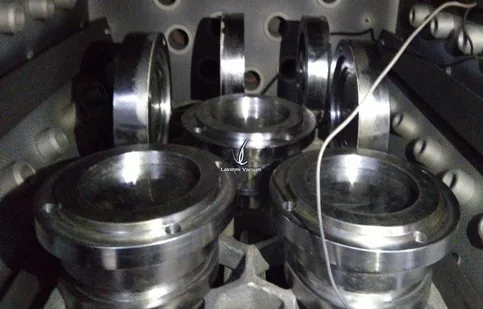
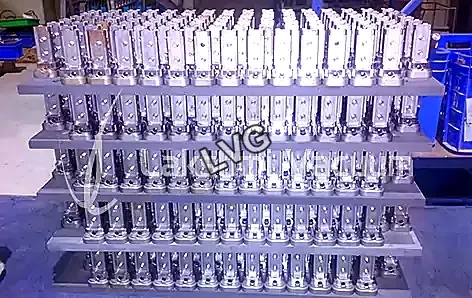
Vacuum-treated parts emerge bright and metallic, often requiring no post-cleaning at all. For components with tight surface finish requirements — such as medical implants, precision bearings, or turbine blades — this is a decisive advantage. The surface integrity is preserved from the machine shop all the way to final assembly.
Environmental & Safety Advantages
Conventional heat treatment using oil quench tanks generates significant environmental and safety liabilities:
- Oil disposal — Quench oil degrades over time and must be replaced, creating hazardous waste streams that require specialized disposal
- Fume emissions — Hot oil produces volatile organic compounds (VOCs) and potentially toxic fumes that require expensive ventilation and scrubbing systems
- Fire risk — Oil quench tanks are a recognized fire and explosion hazard, requiring dedicated fire suppression systems and insurance premiums
- Water contamination — Parts cleaned after oil quenching generate wash water contaminated with oil, requiring additional treatment
Vacuum furnaces with gas quenching eliminate all of these issues. The inert gas (nitrogen or argon) is recirculated within a sealed system — no emissions, no waste, no fire risk. This aligns with the growing regulatory pressure and corporate sustainability mandates that are reshaping manufacturing decisions.
Return on Investment: When Vacuum Makes Economic Sense
The higher capital cost of a vacuum furnace is real — typically 2–4× the price of a comparable atmosphere furnace. But the total cost of ownership tells a very different story:
| Cost Factor | Conventional | Vacuum |
|---|---|---|
| Capital Equipment | Lower initial cost | Higher initial investment |
| Post-Processing (cleaning, blasting) | High value | Near zero |
| Scrap & Rework | 5–12% of batch value | 0.5–2% of batch value |
| Consumables (oil, gas, atmospheres) | High value | Low (N₂ only) |
| Environmental Compliance | Significant ongoing cost | Minimal compliance burden |
For operations processing high-value, precision components — aerospace, medical, automotive powertrain, tooling — the payback period is typically 12–24 months. For lower-value bulk processing, the economics may not justify vacuum, and conventional methods remain appropriate.
Not always. For high-volume, low-value parts where surface quality is not critical, conventional atmosphere furnaces offer faster cycle times at lower capital cost. Vacuum excels with high-value, precision components where surface integrity, minimal distortion, and repeatability are non-negotiable.
Yes. Modern high-pressure gas quenching (10–20 bar) with optimized nozzle designs can achieve cooling rates comparable to oil for most tool steels and alloy steels up to certain cross-section sizes. For very large cross-sections, oil may still cool faster, but vacuum technology is closing this gap rapidly.
Key maintenance includes vacuum pump servicing (oil changes, vane replacement), hot zone inspection (heating elements, insulation), thermocouple calibration, and gas quench fan checks. A well-maintained vacuum furnace has a service life of 20–30 years.
Extremely safe. Nitrogen is an inert, non-flammable gas that makes up 78% of the atmosphere we breathe. There are no fire, explosion, or toxic fume risks. The main safety consideration is ensuring adequate ventilation in case of a large gas release to prevent oxygen displacement in confined spaces.
Vacuum heat treatment is ideal for tool steels (H13, D2, M2), stainless steels, titanium alloys, nickel-based superalloys (Inconel, Hastelloy), and high-performance aerospace alloys. It is also excellent for brazing of dissimilar metals and sintering of cemented carbides.
Evaluating a Vacuum Furnace for Your Process?
Our engineering team can analyze your current heat treatment workflow and provide a detailed feasibility study — including expected ROI, process parameters, and equipment recommendations. Talk to us about our vacuum heat treatment services in India and put these advantages to work in your process.
Request a Feasibility Study