Walk into any precision manufacturing facility after a large batch has come out of the industrial heat treatment process, and you are likely to hear the same frustrations echoing across the shop floor. Parts that left the CNC machine holding exact tolerances are suddenly out of spec.
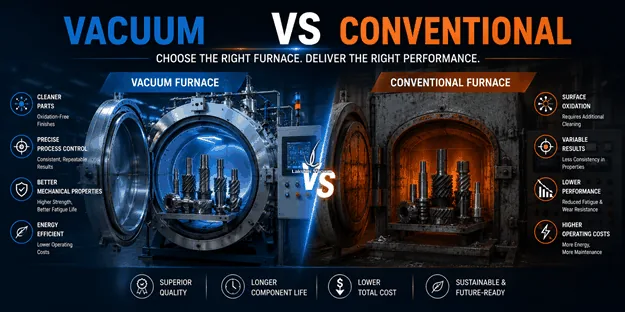
Key Advantages of Vacuum Heat Treatment Furnace
- Oxidation-free parts — Prevents scale and oxidation, eliminating post-cleaning
- Uniform cooling — Provides controlled, consistent cooling for complex geometries
- Precise process control — Ensures repeatable temperature and metallurgical results
- Environmentally friendly — No oil or hazardous waste produced
- Enhanced mechanical properties — Achieves high hardness and strength without contamination
- Safer operation — Inert gases reduce fire hazards
- Minimal distortion — Reduces thermal gradients, minimizing warpage
- High-quality surface finish — Maintains pristine surfaces without post-processing
Vacuum vs Conventional: Direct Comparison
| Parameter | Atmosphere Heating | Vacuum Heat Treatment |
|---|---|---|
| Furnace Environment | Controlled gases (air, N₂, H₂, etc.) | Low-pressure vacuum, sometimes with inert gases |
| Oxidation Control | Requires controlled atmosphere to prevent oxidation | No oxidation — absence of oxygen |
| Surface Quality | Risk of surface oxidation or scaling | Clean, oxidation-free surfaces |
| Heat Transfer | Convection | Radiation |
| Temperature Uniformity | Moderate (depends on design & gas flow) | High (±6°C even distribution) |
| Gas Composition Control | Crucial for carburizing/nitriding | Minimal, except trace gases like H₂ |
| Material Suitability | Broad range, especially steel & alloys | High-performance (aerospace, medical) |
| Cycle Time | Faster due to gas heating | Slower due to heat-up/cool-down in vacuum |
| Equipment Cost | Less expensive, simpler design | Higher capital investment, complex system |
The Reality of Conventional Furnace Processing
In practice, maintaining a perfectly stable atmospheric chemistry across a multi-hour cycle is incredibly difficult. Even minor variations in the gas composition lead to severe metallurgical consequences:
Surface Oxidation
Trace oxygen reacts with alloying elements in the steel, forming an oxide scale that degrades surface integrity.
Decarburization
The furnace atmosphere strips carbon atoms from the surface — creating a soft, carbon-depleted layer where maximum hardness is needed.
Intergranular Oxidation
Oxygen penetrates grain boundaries, creating micro-voids that act as stress risers, initiating premature fatigue failures.
How Vacuum Heat Treatment Changes the Physics
Vacuum heat treatment removes the root cause of these issues—the atmosphere itself. Inside a vacuum furnace, heavy-duty pumping systems evacuate the chamber to very low pressures, often down to 10⁻² mbar. Heat transfer shifts from convection to pure radiation, ensuring every part undergoes the exact same phase transformation.
Critical Advantage: Gas Quenching
Instead of dunking a red-hot part into volatile oil, vacuum furnaces use high-pressure inert gas quenching. The chamber is rapidly backfilled with ultra-pure nitrogen or argon (up to 12–15 bar pressure), and high-capacity internal fans circulate the gas at high velocities to cool the parts uniformly.
Quenching Differences: Oil vs Gas
Oil Quenching (Conventional)
- Vapor blanket forms instantly, insulating the part
- Vapor collapse leads to violent heat extraction
- Creates massive, uneven thermal gradients
- Leaves oil residue requiring extensive cleaning
Result: High distortion, fire hazard.
Gas Quenching (Vacuum)
- Chamber backfilled with ultra-pure N₂ or Ar at 6–20 bar
- Steady, uniform convective cooling from all directions
- No phase change, meaning no thermal shock
- Part emerges clean, bright, and ready for use
Result: Minimal distortion, clean surface.
Return on Investment: When Vacuum Makes Economic Sense
| Cost Factor | Conventional | Vacuum |
|---|---|---|
| Capital Equipment | Lower initial cost | Higher initial investment |
| Post-Processing | High value | Near zero |
| Scrap & Rework | 5–12% of batch value | 0.5–2% of batch value |
| Consumables | High value | Low (N₂ only) |
| Environmental Compliance | Significant ongoing cost | Minimal compliance burden |
For operations processing high-value, precision components, the payback period is typically 12–24 months.
Frequently Asked Questions
Not always. For high-volume, low-value parts where surface quality is not critical, conventional atmosphere furnaces offer faster cycle times at lower capital cost. Vacuum excels with high-value, precision components where surface integrity and minimal distortion are non-negotiable.
Yes. Modern high-pressure gas quenching (10–20 bar) with optimized nozzle designs can achieve cooling rates comparable to oil for most tool steels and alloy steels up to certain cross-section sizes.
Key maintenance includes vacuum pump servicing, hot zone inspection (heating elements, insulation), thermocouple calibration, and gas quench fan checks. A well-maintained furnace lasts 20–30 years.
Ideal for tool steels (H13, D2, M2), stainless steels, titanium alloys, nickel-based superalloys (Inconel), and high-performance aerospace alloys. Also excellent for brazing dissimilar metals.
Evaluating a Vacuum Furnace for Your Process?
Our engineering team can analyze your current heat treatment workflow and provide a detailed feasibility study. Talk to us about our vacuum heat treatment services and put these advantages to work.
Request a Feasibility Study