One chamber, two orbital conditions
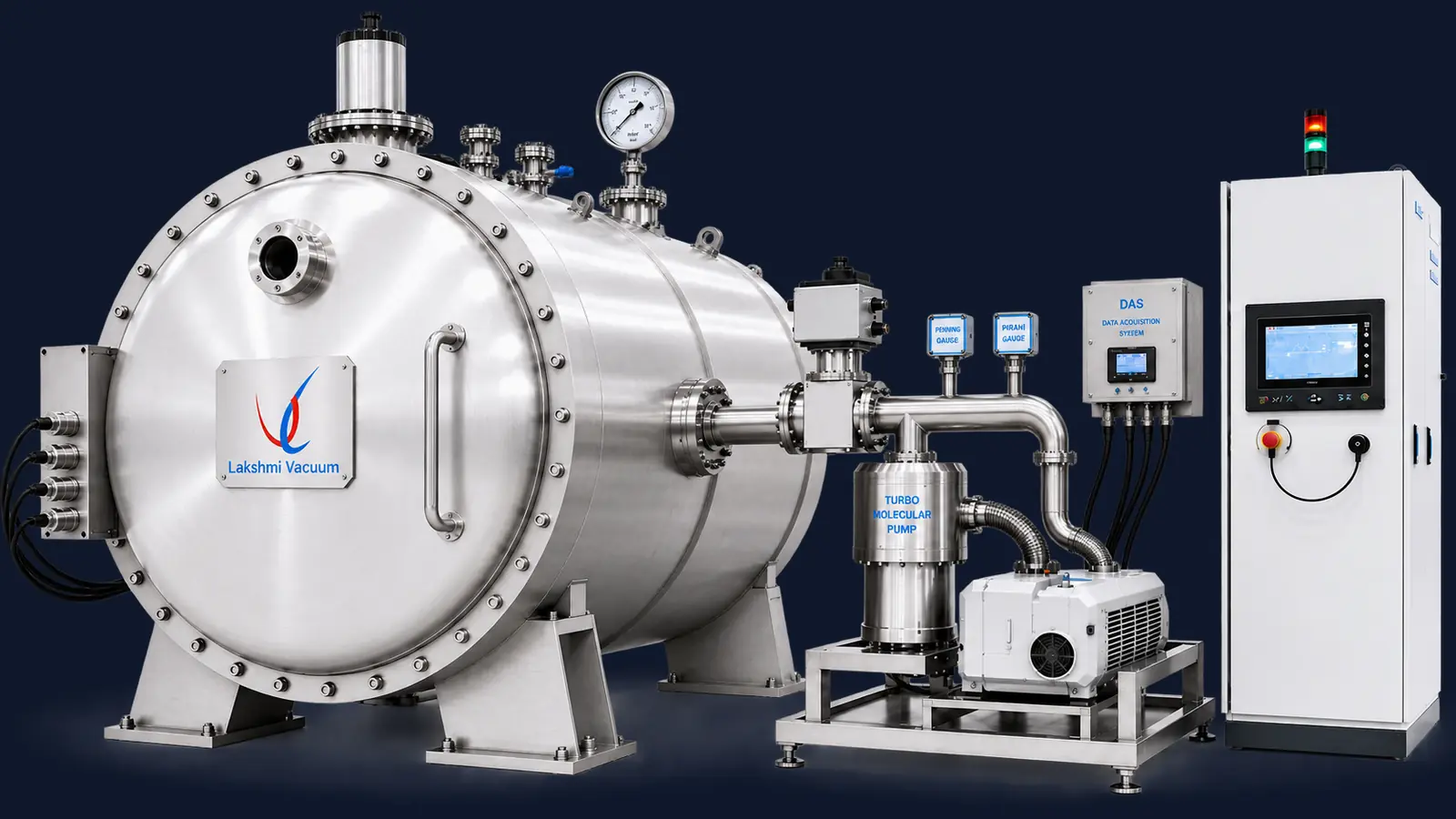
One chamber reproduces the two conditions that define orbit: high vacuum at 5×10⁻⁶ mbar and thermal cycling from −196°C to +250°C. LN₂-cooled shrouds drive the deep-cold soak; a fully oil-free pumping train keeps the vacuum clean enough for optics and flight electronics. Shroud and baseplate run on independent PID loops with external Pt100 sensing, holding ±1°C across the thermal plate — so a qualification, thermal-balance or outgassing cycle repeats exactly, run after run.
Built to aerospace external-pressure practice
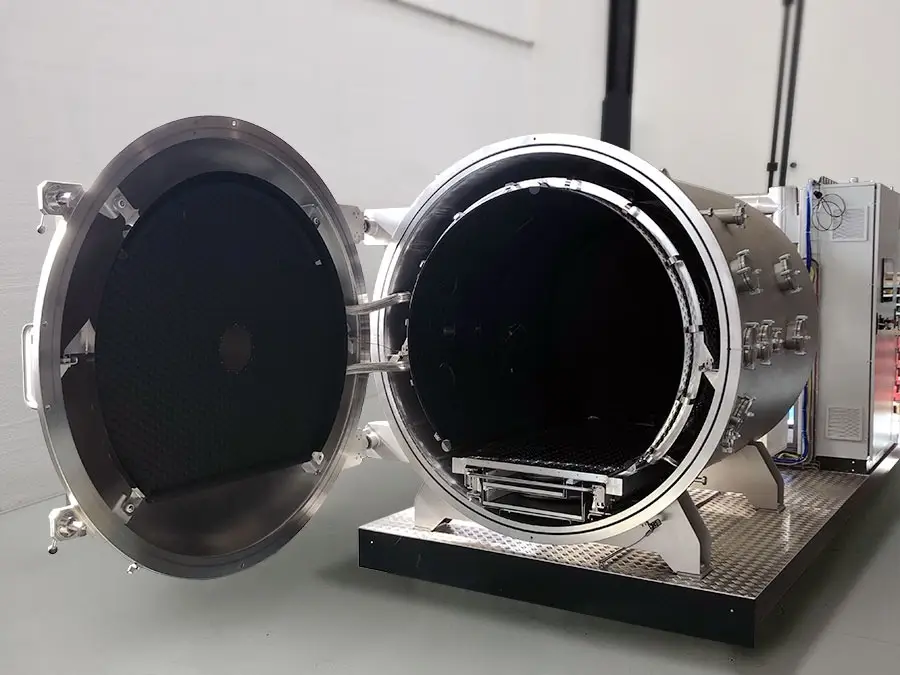
The chamber is a horizontal cylindrical vessel in SS 304L, with a torispherical dished end and a front-loading door, designed to ASME BPVC Section VIII Division 1 external-pressure rules. A full thermal shroud surrounds the test article to set the radiative sink temperature, and the thermal plate is sized so the article sees an even temperature field across its surface.
- ✓Two-stage thermal circulator — independent shroud and baseplate loops, −70°C to +150°C, external Pt100 input
- ✓Oil-free pumping system — dry backing and turbomolecular stages for hydrocarbon-free vacuum
- ✓Automated PID feedthroughs — electrical and power feedthroughs to pin specification, recipe control with cycle logging
- ✓+250°C bakeout for chamber conditioning, outgassing and clean-vacuum recovery
A typical qualification cycle
Uniformity ±1°C across the thermal plate, with fully programmable ramp rates, holds and dwells set by recipe.
Configurable to the test article
Chamber volume, shroud, pumping train and instrumentation are engineered around your article and your test standard.
On shroud and baseplate, held at 5×10⁻⁶ mbar (153–423 K).
LN₂-cooled shroud (77 K) for deep-space cold-side simulation.
Chamber conditioning for outgassing and clean-vacuum recovery.
5×10⁻⁴ Pa · 3.8×10⁻⁶ Torr, reached with an oil-free pumping train.
Across the thermal plate, with programmable heating and cooling rates.
Torispherical dished end, front-loading door, full-vacuum external pressure design.
Designed to ASME BPVC Sec. VIII Div 1 external-pressure rules; aerospace practice.
Surrounds the test article to set the radiative sink temperature.
Plate thickness engineered so the article sees an even temperature field.
Independent shroud and baseplate loops, −70°C to +150°C, external Pt100 input.
Dry backing and turbomolecular stages — hydrocarbon-free vacuum for flight hardware.
Electrical and power feedthroughs to pin specification; recipe control with cycle logging.
Satellite and payload qualification · thermal balance and thermal cycling · avionics, optics and sensor screening · outgassing and TVAC bakeout · battery, propulsion and actuator testing · acceptance testing of flight and EM units.
Two decades of thermal processing leadership
Lakshmi Vacuum Group builds vacuum furnaces and runs a nationwide vacuum heat treatment network — serving aerospace, automobile, defence and precision tooling. Furnaces are built to order in Bengaluru across a wide range of platforms and work zones; eight service hubs across India process customer parts on the same technology.
“We don't just manufacture vacuum furnaces — we've operated them ourselves for over 23 years. That hands-on experience is engineered into every furnace we build.”
We will size the chamber.
Chamber volume, shroud, pumping train and instrumentation are engineered around your article and your test standard. Two decades of operating vacuum furnaces ourselves goes into every system we build.