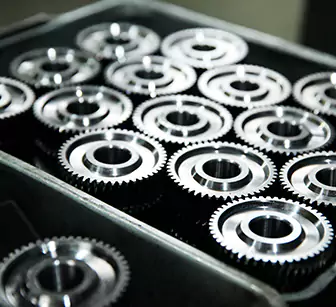
Vacuum Carburizing for Gear Manufacturing
Gears demand a hard, wear-resistant surface and a tough, ductile core. Low-pressure vacuum carburizing (LPC) with high-pressure gas quenching (HPGQ) delivers both — without intergranular oxidation, without oil quench distortion, and without the environmental burden of atmosphere carburizing. This is why automotive Tier 1 suppliers are switching from conventional carburizing to vacuum.
The Industry: Gear Heat Treatment
Transmission gears are typically made from case-hardening steels — 20MnCr5, 16MnCr5, 20CrMo5, or SAE 8620. The heat treatment process creates a hard, carbon-enriched case (0.5 to 2.0 mm depth) on a tough, low-carbon core. Surface hardness targets are typically 58 to 62 HRC; core hardness is 30 to 45 HRC. The combination gives the gear both wear resistance at the tooth flank and impact resistance at the core.
Conventional atmosphere carburizing uses endothermic gas and oil quenching. It works — but it produces intergranular oxidation (IGO) at the surface, which reduces fatigue life, and oil quenching causes dimensional distortion that requires post-hardening grinding. Vacuum carburizing eliminates both problems.
Surface HRC
Core HRC
Case Depth (mm)
IGO Tolerance
The Technical Challenge
Conventional atmosphere carburizing + oil quenching creates three problems that gear manufacturers cannot ignore:
Atmosphere carburizing introduces oxygen at the surface, which penetrates along grain boundaries. IGO reduces bending fatigue strength by 20–40% and is a major cause of premature gear failure.
Oil quenching creates uneven cooling, causing gear distortion — ovality, taper, and gear pitch errors. Post-hardening grinding adds cost and material waste.
Complex gear geometries — teeth, splines, blind bores — need uniform case depth everywhere. Atmosphere carburizing struggles with carbon penetration in blind holes and tight clearances.
Oil quenching produces smoke, fumes and fire risk. Endothermic generators consume gas. EU and global regulations are pushing manufacturers toward clean, oil-free processes.
The Solution: LPCF Low-Pressure Carburizing + HPGQ
The LPCF Series combines low-pressure vacuum carburizing with 15-bar high-pressure gas quenching. Carburizing happens in vacuum using acetylene or propane pulses at 10–13 mbar — no oxygen, no IGO. Quenching uses pressurised nitrogen or helium — no oil, no smoke, and far lower distortion.
Technical Insight: Why Vacuum Carburizing for Gears
Low-pressure carburizing (LPC) works fundamentally differently from atmosphere carburizing. Instead of surrounding the part with endothermic gas, LPC pulses acetylene or propane into a vacuum chamber at low pressure (typically 5–15 mbar). The hydrocarbon gas cracks on the hot part surface, depositing carbon directly. Between pulses, the carbon diffuses into the steel.
- Zero IGO: No oxygen in the chamber means no intergranular oxidation. The surface stays clean and fatigue strength is preserved.
- Uniform case depth: Acetylene at low pressure penetrates blind bores, splines and tight clearances better than endothermic gas. Case depth is more uniform across complex geometries.
- Lower distortion: Gas quenching at 15 bar gives more uniform cooling than oil, because the gas flow can be directed and controlled. Less grinding after hardening means lower cost and less scrap.
- Precise carbon control: The boost-diffuse pulse pattern is computer-controlled, giving repeatable carbon profiles. Case depth and surface carbon are stored as recipes and reproduced batch after batch.
- Clean and dry: No oil means no washing, no smoke, no fire risk. Parts come out bright and clean — ready for inspection or assembly without post-process cleaning.
Industry Context: Why This Matters
India's automotive sector is one of the world's largest by production volume. The transition to BS-VI emission norms has driven investment in cleaner manufacturing processes. EV adoption is changing gear requirements — fewer gears per vehicle, but higher torque loads on the remaining gears, which means higher hardening standards.
For Tier 1 suppliers serving European OEMs, IATF 16949 certification requires full process traceability — every gear must be traceable to its heat treatment cycle. Vacuum carburizing with PLC/SCADA recipe logging gives this traceability natively; atmosphere carburizing does not.
Process Outcomes
When the LPCF furnace is configured correctly for gear carburizing, the outcomes are measurable and repeatable:
- IGO-free surfaces — verified by metallographic sectioning, with zero oxidation penetration at grain boundaries
- Surface hardness 58–62 HRC with case depth controlled to ±0.1 mm across complex geometries including blind bores and splines
- Lower distortion than oil quench — gas quenching at 15 bar gives more uniform cooling, reducing post-hardening grinding stock by 30–50%
- Clean, bright parts — no oil residue, no cleaning required, parts go straight to inspection or assembly
- Recipe-based process control with full SCADA data logging — every cycle traceable, which IATF 16949 automotive auditors require
Why LPC + HPGQ Design Matters for Gears
Clean processNo oil, no smoke, no fire risk — fully eco-friendly operation that meets EU environmental norms
FlexibilityProgrammable recipes for 20MnCr5, 16MnCr5, 20CrMo5 and other case-hardening steels
Cost savingsLess grinding stock, lower scrap rate, no washing step, no oil disposal costs
Full traceabilitySCADA recipe logging gives batch records that IATF 16949 automotive auditors require
CE compliantFurnace systems are CE-certified for deployment in European facilities, with safety interlocks, overpressure protection and purge systems
Why Lakshmi Vacuum?
- One of India's few 15-bar HPGQ furnace OEMs — integrated LPC + gas quench in one system
- In-house process metallurgy — we help you develop the carburizing recipe for your gear steel and case depth spec
- CE-certified furnace systems for global deployment, including European Tier 1 suppliers
- Hands-on operator training and remote diagnostics support
- 450+ furnaces delivered since 2003 to customers in 9 countries, including automotive and aerospace supply chains
For full specifications of the LPCF series, see our Vacuum Carburizing Furnace product page or request a quotation.
Conclusion
Vacuum carburizing with 15-bar gas quenching is replacing atmosphere carburizing + oil quench for gears because it solves three problems at once: IGO, distortion and environmental impact. The LPCF series is engineered for this application — acetylene pulse carburizing in vacuum for uniform case depth, high-pressure gas quench for low distortion, and SCADA recipe control for full traceability. As emission norms tighten and IATF 16949 traceability requirements grow, vacuum carburizing is becoming the standard for high-performance gear manufacturing.
Carburizing Gears?
Tell us your steel grade, case depth and batch size. We'll configure the right vacuum carburizing furnace for your gear line.
Let's Build Your Furnace
From concept to commissioning — turnkey vacuum carburizing solutions for automotive and industrial gears.
Request a Quote