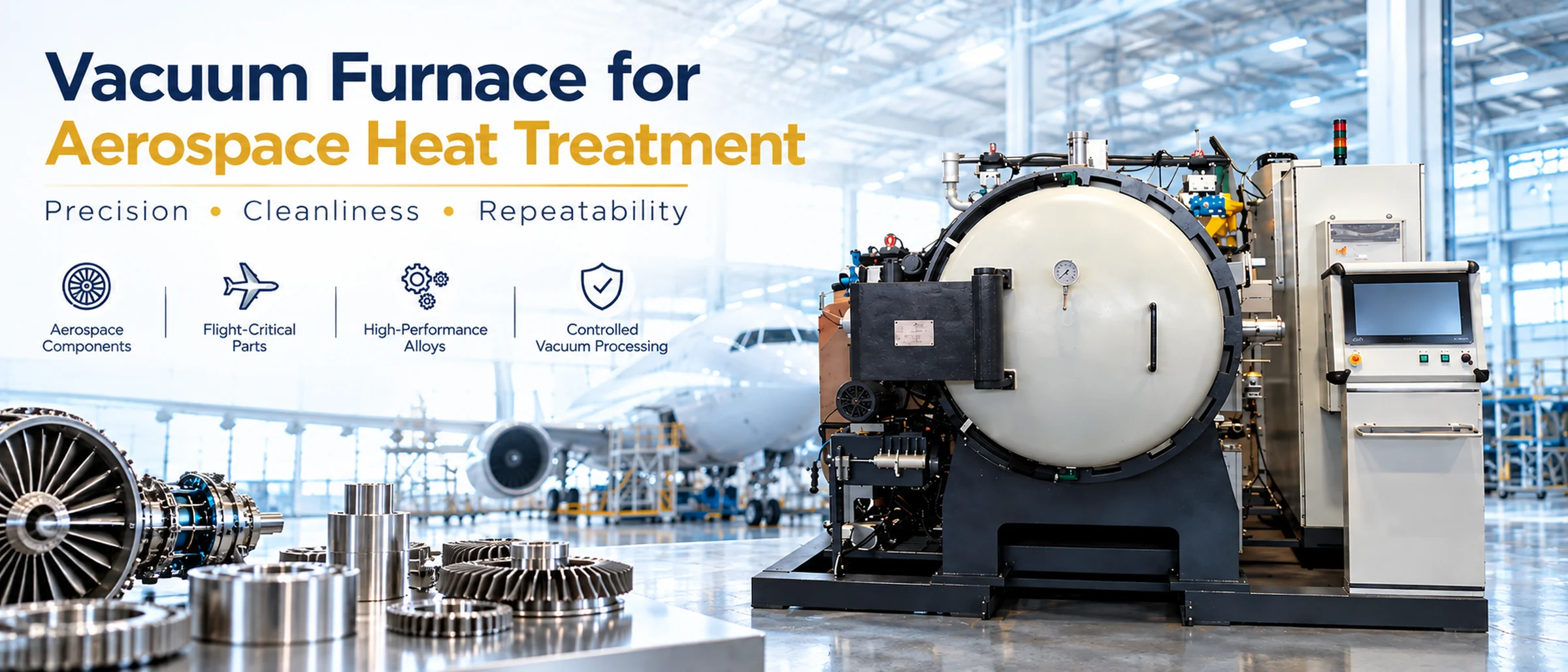
In the aerospace industry, there is no room for error. Every single component fitted onto an aircraft or spacecraft must perform flawlessly under extreme, unforgiving conditions. From the immense stress of takeoff to the freezing temperatures at high altitudes, the materials used in these applications are pushed to their absolute limits.
To survive this, raw metals are not enough; they require precise structural manipulation. This is where thermal processing comes in. However, traditional methods often introduce new problems, such as surface contamination or structural distortion. A specialized aerospace vacuum heat treatment furnace (VHF) has become the definitive solution, providing a pristine, controlled environment that ensures parts achieve their required metallurgical properties without the risk of surface degradation.
In aerospace manufacturing, even a minor atmospheric inconsistency during the heating phase can lead to serious performance risks. The vacuum environment eliminates this variable entirely.
What is an Aerospace Vacuum Heat Treatment Furnace?
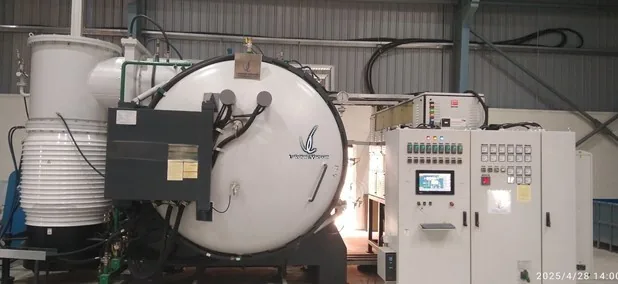
An aerospace vacuum heat treatment furnace is a specialized industrial system that processes metal components in a highly controlled, oxygen-free environment. By removing atmospheric gases, it prevents surface oxidation and contamination while delivering precise, uniform heating and cooling to meet strict aviation metallurgical standards.
Our aerospace vacuum furnaces are built to meet strict quality and certification requirements including AMS 2750 — ensuring temperature accuracy and uniformity, and NADCAP — ensuring process control, traceability, and repeatability. These standards are critical because aerospace components operate under extreme stress, temperature, and safety conditions.
Why the Aerospace Industry Requires a Vacuum Furnace
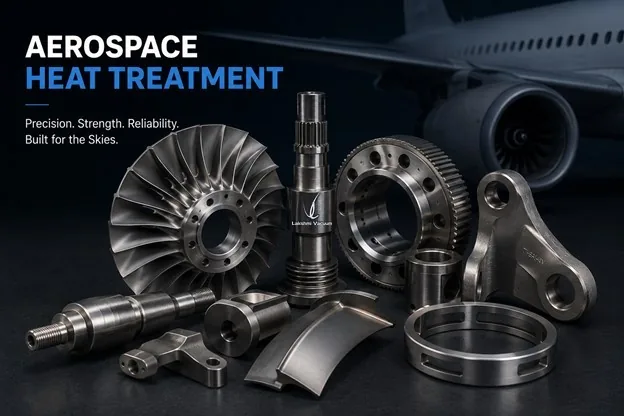
Aerospace manufacturing is fundamentally different from general industrial production. The components involved—ranging from turbine blades to landing gear—are often made from exotic, high-value alloys like titanium, Inconel, and specialized stainless steels. These materials are highly sensitive to their surrounding environment when heated.
The core objective of aerospace thermal processing is to enhance mechanical properties: increasing tensile strength, improving fatigue resistance, and maximizing toughness. However, achieving these internal changes is only half the battle. If the process compromises the exterior of the part, the component is essentially scrap.
Traditional atmosphere furnaces, which rely on reactive gases to prevent oxidation, can still interact with sensitive aerospace alloys. This can cause decarburization (loss of carbon at the surface) or hydrogen embrittlement. Furthermore, aerospace tolerances are incredibly tight. Even microscopic distortion during the heating and cooling phases can render a multi-million-dollar component useless.
Therefore, the industry demands a specialized approach that guarantees absolute cleanliness, uniform heating, and zero contamination. Essentially, a vacuum furnace treats metal in a void—it is the cleanest possible processing environment available in industrial manufacturing.
Key Benefits of Vacuum Furnace for Aerospace
The shift from traditional methods to vacuum technology in aerospace manufacturing is driven by several distinct advantages that directly impact part reliability and the bottom line.
Applications in Aerospace Manufacturing
The unique capabilities of vacuum technology make it indispensable across nearly every subsystem of an aircraft.
Turbine Components
Jet engine turbine blades and discs operate in the hottest part of the engine. These parts require complex thermal cycles to maintain their strength at extreme operating temperatures. Vacuum processing ensures these superalloys do not suffer from elemental depletion at their surfaces.
Engine Parts
Components such as compressor casings, shafts, and seals require high surface integrity and precise dimensional stability. Vacuum hardening and tempering provide the necessary core strength while keeping the surface pristine, ensuring these rotating parts fit together perfectly.
Structural Components
Landing gear, wing spars, and fuselage fittings are subjected to immense cyclic loading. Vacuum processing prevents the hydrogen embrittlement that can occur in traditional gas-fired furnaces, ensuring the structural integrity of the airframe.
From turbine blades to landing gear struts, vacuum heat treatment for aerospace components ensures that every part achieves its optimal structural properties while maintaining exact dimensional tolerances.
Vacuum Brazing in Aerospace
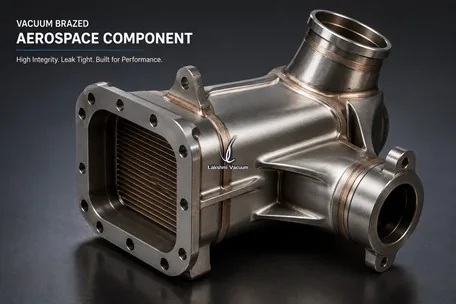
While heat treatment alters the properties of a single metal, brazing joins separate metals together. In aerospace, brazing is used to manufacture complex, lightweight structures like heat exchangers, fuel systems, and intricate sensor housings.
Conventional brazing requires chemical fluxes to clean the metal surfaces and facilitate the flow of the braze alloy. The problem is that these fluxes leave behind corrosive residues that are incredibly difficult to remove from complex internal passages. If residue remains, it can cause catastrophic failure in a fuel or hydraulic system.
An aerospace vacuum brazing furnace eliminates the need for flux entirely. The vacuum environment actively cleans the metal surfaces as temperature rises, drawing off residual surface oxides. The braze alloy flows perfectly into joint gaps in a pristine environment—resulting in immense structural strength, zero voids, and absolutely no corrosive residue.
Industry Standards & Quality Expectations
In aerospace, trust is not given; it is proven through rigorous auditing and compliance. Facilities performing thermal processing for aerospace are almost universally required to hold certifications like AS9100. Furthermore, the actual equipment and processes must comply with specifications laid out by SAE International, commonly known as AMS (Aerospace Material Specifications).
You cannot simply claim your furnace produces good parts—you must prove that your equipment, processes, and quality controls meet stringent international standards. More importantly, aerospace primes usually require NADCAP accreditation.
NADCAP audits are famously rigorous—they examine the furnace's temperature uniformity surveys, the calibration of instruments, the vacuum leak rates, and the training of the operators. Selecting equipment that is inherently capable of meeting these strict parameters is the first step in achieving these critical industry certifications.
How to Select a Vacuum Furnace for Aerospace
Investing in vacuum thermal processing equipment is a major capital expenditure. Plant heads and procurement managers must evaluate systems based on long-term value rather than just the initial price tag.
- Customization for Workload — Aerospace parts vary drastically in size and mass. The right manufacturer will analyze your specific workload to design a chamber size and pumping system that maximizes your throughput.
- Process Compatibility — A system optimized for vacuum brazing requires different capabilities than one built for high-pressure hardening. Ensure the equipment is specifically engineered for your intended metallurgical processes.
- Reliability and Uptime — Furnace downtime can halt an entire assembly line. Chamber construction robustness, insulation material quality, and vacuum pumping package reliability are critical long-term factors.
- After-Sales Support — Thermal processing equipment requires ongoing maintenance and calibration. Rapid technical support, ready spare parts access, and comprehensive training are as important as the equipment itself.
Why Choose Lakshmi Vacuum?
When the integrity of flight-critical components is at stake, the choice of equipment partner carries immense weight. Designing and building a vacuum furnace is a complex engineering challenge that requires deep knowledge of thermal dynamics, metallurgy, and vacuum physics.
As a leading vacuum furnace manufacturer in India, Lakshmi Vacuum understands that our clients are not just buying a piece of machinery—they are investing in a guarantee of metallurgical perfection. Our engineering team works closely with aerospace suppliers to understand their specific material challenges. Whether you require a standard batch furnace for routine vacuum heat treatment for aerospace components or a highly customized system, we build equipment engineered for absolute reliability.
Conclusion
The aerospace industry operates at the absolute edge of material science. As aircraft become more efficient and engines run hotter, the demands placed on foundational processes like heat treatment will only intensify. Relying on outdated atmospheric methods introduces unnecessary risks—risks that manifest as surface contamination, part distortion, and compromised fatigue life.
A dedicated aerospace vacuum heat treatment furnace eliminates these variables entirely. By providing an isolated, pristine environment, vacuum technology ensures that aerospace components achieve their optimal structural properties while maintaining exact dimensional tolerances and bright, clean surfaces. As the sector continues to advance, partnering with an experienced, engineering-driven vacuum furnace manufacturer will be critical for suppliers looking to meet the rigorous demands of tomorrow's aerospace landscape.
Frequently Asked Questions
Vacuum heat treatment eliminates oxygen, preventing surface oxidation and decarburization. It also provides superior temperature uniformity, which drastically reduces the risk of part distortion compared to traditional atmosphere furnaces.
A vacuum furnace uses specialized pumping systems to remove atmospheric air from the heating chamber before the cycle begins. Without oxygen present in the environment, the metal cannot oxidize, resulting in a bright, clean surface finish.
Yes, vacuum furnaces are extensively used for aerospace vacuum brazing. The vacuum environment eliminates the need for chemical fluxes, ensuring clean, strong joints without the risk of corrosive residue left behind in complex internal passages.
Look for a manufacturer with proven engineering expertise, the ability to offer customized chamber sizes and pumping packages, robust after-sales support, and a track record of building equipment capable of passing strict aerospace quality audits like NADCAP.
No. It is a premium process. While it provides superior quality, it represents a higher initial investment compared to conventional atmosphere furnaces. The decision depends on the criticality of the components and the required surface quality.
Key safety measures include proper handling of high temperature systems, gas safety protocols (especially hydrogen), continuous cooling water monitoring, and pressure relief systems for quenching operations. All safety systems must comply with applicable industrial safety standards.
Ready to Elevate Your Aerospace Thermal Processing?
Choosing the right thermal processing partner is critical to maintaining your aerospace quality certifications and reducing operational downtime. Explore our aerospace vacuum heat treatment furnaces, or reach out for vacuum furnace spares and service support.
Contact Our Engineers