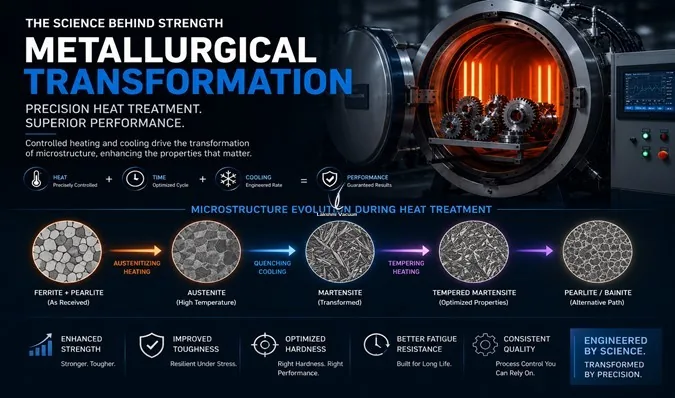
When you pick up a precision aerospace component or a high-performance gear, you aren't just holding a piece of metal. You are holding a snapshot of a thermodynamic battle fought at the atomic level. Whether a gear endures a million cycles or fails catastrophically rarely depends on the steel's chemistry alone. It depends on how the internal structure was manipulated. This is the domain of metallurgical transformations in vacuum heat treatment.
As engineers, we don't just heat metal to change its temperature; we heat it to alter its crystal lattice, forcing the material to adopt specific properties that raw, untreated steel simply cannot possess.
What are Metallurgical Transformations?
Metallurgical transformations in vacuum heat treatment are the deliberate alterations of a metal's internal crystal structure and phase composition, driven by precisely controlled heating and cooling cycles. These transformations rearrange atoms at the microscopic level, directly dictating the mechanical properties of the component, such as hardness, toughness, and ductility.
Understanding Metallurgical Transformations
To master heat treatment, we must stop viewing metal as a static solid and start seeing it as a dynamic system. At room temperature, atoms in steel are locked into a specific arrangement. Introducing thermal energy causes intense vibration, breaking bonds and shifting the structure.
We use this instability to our advantage. Heating steel into the austenitic range transforms it into a face-centered cubic lattice capable of dissolving high amounts of carbon. Slow cooling allows carbon to precipitate out, softening the metal. Rapid cooling traps that carbon inside the lattice, creating immense internal stress and hardness.
These phase transformations in steel are predictable physical changes that we exploit to solve complex engineering problems. Controlling the metallurgical transformations in steel vacuum heat treatment process is what allows us to tailor material performance to specific application demands.
Key Phase Transformations
1. Austenite to Martensite Transformation
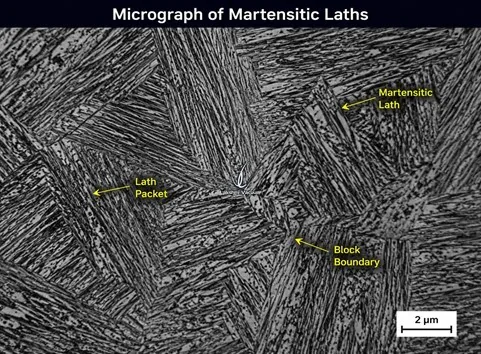
This is the most critical transformation for hardening. When steel is heated above its critical temperature, it transforms into Austenite, a structure that absorbs significant carbon. During rapid quenching, carbon atoms cannot diffuse out of the crystal lattice. The structure undergoes a diffusionless shear transformation into Martensite—a body-centered tetragonal structure supersaturated with carbon. This "frozen" state is extremely hard and brittle.
The austenite to martensite transformation is the primary mechanism for creating wear-resistant surfaces in tools and bearings.
2. Pearlite Formation
If the cooling rate is slow (such as in furnace cooling or annealing), carbon has time to precipitate out of the solution. It combines with iron to form Iron Carbide (Cementite) and alternates with layers of pure Ferrite. This lamellar structure is Pearlite. It is generally softer and more ductile than Martensite. While not ideal for high-wear surfaces, Pearlite offers excellent machinability and is often the desired outcome for parts requiring subsequent cold forming.
3. Bainite Transformation
Bainite forms at cooling rates faster than Pearlite but slower than Martensite, typically requiring an isothermal hold. It consists of a non-lamellar mixture of ferrite and cementite. We often see Bainite in applications requiring a balance of strength and toughness where the extreme brittleness of Martensite would be a liability. It provides good fatigue resistance and is commonly targeted in high-strength automotive fasteners.
Microstructure Importance
The resulting microstructure dictates the macro-scale behavior of the part. You cannot specify hardness without considering the microstructure changes during vacuum heat treatment:
TTT and CCT Diagrams
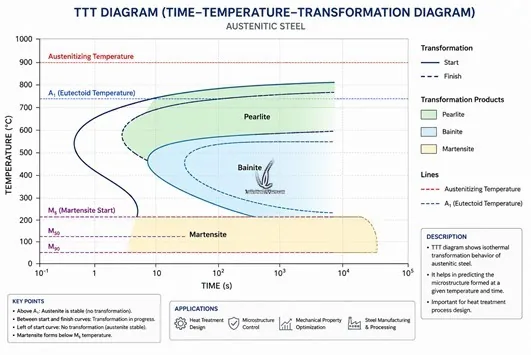
Engineering relies on data, not guesswork. We use Time-Temperature-Transformation (TTT) and Continuous Cooling Transformation (CCT) diagrams to plan our thermal cycles. These are not just academic curves; they are essential tools for process planning.
| Diagram Type | Method | Best For | Industry Use |
|---|---|---|---|
| TTT Diagrams | Constant temperature over time | Isothermal processes | Austempering planning |
| CCT Diagrams | Continuous cooling | Real-world furnace cycles | Full hardening optimization |
The "nose" of the CCT curve is the critical zone. If the cooling curve cuts through the nose, soft Pearlite forms. If the curve skirts the nose, we achieve full hardening with Martensite formation.
The Role of Vacuum Heat Treatment
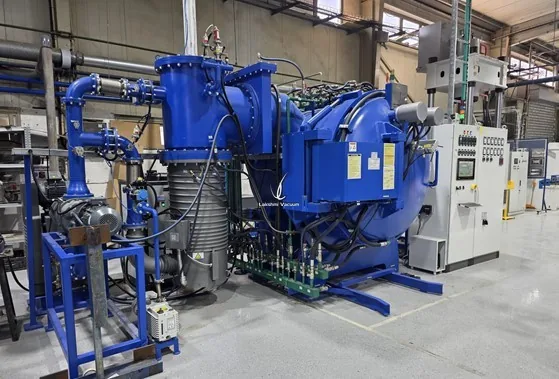
Executing these transformations requires precise control over the atmosphere and temperature. This is where the vacuum heat treatment process proves superior to conventional atmosphere furnaces. At Lakshmi Vacuum, we prioritize environment control for several reasons:
- Oxidation-Free Environment — Atmospheric furnaces introduce surface oxidation and decarburization, creating a soft surface layer. Vacuum eliminates reactive gases, ensuring the austenite to martensite transformation occurs uniformly right to the surface.
- Bright Finish — Without oxidation, parts emerge clean and bright. This eliminates post-processing like pickling or blasting, reducing cost and lead time.
- Uniform Heating — Vacuum furnaces use radiant heat transfer, providing exceptional temperature uniformity across complex geometries. This ensures consistent microstructure changes during vacuum heat treatment throughout the entire part.
- Controllable Cooling — With gas quenching capabilities (nitrogen, argon, or helium), we can precisely tune cooling rates to target specific phases — whether that's full Martensite, Bainite, or a controlled mixed structure.
Industrial Applications
The ability to control metallurgical transformations in steel vacuum heat treatment process has far-reaching implications across industries:
Common Challenges in Controlling Transformations
Even with advanced equipment, several factors can derail the desired phase transformations in steel:
Advanced Transformation Control Techniques
Modern vacuum heat treatment offers sophisticated methods to overcome these challenges:
Austempering — Holding at a temperature in the Bainite region to produce a tough, wear-resistant structure without the brittleness of Martensite. Ideal for springs and impact-loaded components.
Sub-critical Annealing followed by Hardening — Refines the starting grain structure before the final hardening cycle, resulting in a finer, more uniform Martensitic microstructure with improved toughness.
Quality Verification
Verifying that the intended metallurgical transformations in vacuum heat treatment have occurred correctly requires systematic testing:
- Hardness Testing — Vickers, Rockwell, or Brinell testing at multiple locations to verify uniform transformation across the part.
- Metallographic Examination — Cross-sectional polishing and etching to visually confirm the microstructure matches specifications.
- Case Depth Measurement — For carburized parts, verifying the effective case depth ensures the hard layer meets design requirements.
- Retained Austenite Measurement — X-ray diffraction to quantify any untransformed Austenite that could affect long-term stability.
- Dimensional Inspection — CMM or precision gauging to verify distortion is within acceptable tolerances post-treatment.
The quality of heat treatment is not measured by what the furnace displays — it is measured by what the microstructure reveals under a microscope.
Conclusion
Understanding and controlling metallurgical transformations in vacuum heat treatment is what separates reliable, high-performance components from unpredictable failures. Every phase transformation — whether Austenite to Martensite, Pearlite formation, or Bainite development — represents a deliberate choice in the engineering of material properties.
At Lakshmi Vacuum, our advanced vacuum furnaces provide the atmospheric purity, temperature uniformity, and quench control necessary to execute these transformations with precision. Whether you need full hardening, case carburizing, or specialized treatments like austempering, our engineering team understands the metallurgy behind every thermal cycle.
Key Takeaway: The difference between a component that performs and one that fails often comes down to microstructure. Master the transformations, and you master the material.
Frequently Asked Questions
The austenite to martensite transformation is the most critical. It occurs during rapid quenching when carbon atoms are trapped in the crystal lattice, creating extreme hardness. This transformation is diffusionless — it happens almost instantaneously through a shear mechanism rather than atomic diffusion.
Vacuum eliminates oxygen and other reactive gases, preventing surface oxidation and decarburization. This means the phase transformations in steel occur uniformly right to the surface, producing consistent hardness without a soft, decarburized layer that atmosphere furnaces typically create.
Yes. By programming an isothermal hold at the appropriate temperature (typically 250-400°C depending on the steel grade) after austenitizing, Bainite can be formed. This process, called austempering, produces a structure with excellent toughness and is well-suited to vacuum furnace capabilities.
Retained Austenite occurs when the cooling rate is insufficient or the alloy has high carbon content, preventing complete transformation to Martensite. It can be problematic because it is metastable — it may transform over time, causing dimensional changes. Cryogenic treatment or multiple tempers can convert retained Austenite to Martensite.
These diagrams map the time and temperature conditions under which each phase forms. TTT diagrams show transformations at constant temperature (isothermal), while CCT diagrams show transformations during continuous cooling. They allow engineers to predict whether a given cooling rate will produce Martensite, Bainite, or Pearlite, enabling precise process design.
Need Expert Vacuum Heat Treatment?
Our metallurgical engineering team can help you select the right thermal cycle for your application and material specification — and put it into production with our vacuum heat treatment services.